
Table of Contents
- Exhaust Backpressure: A Limit Set by the Manufacturer
- What Causes Pressure Drop in an Exhaust Muffler
- CFD Simulation: Sizing Back Pressure Before Manufacturing
- SM EVO 2: An Exhaust Muffler Designed Using CFD
- From Prototype to Production: Consistent Performance Across Every Unit
- Backpressure in an exhaust silencer: key takeaways
- Frequently Asked Questions
Exhaust Back Pressure: A Budget Set by the Manufacturer
Back pressure is the pressure that the exhaust system exerts against the flow of exhaust gases. The engine manufacturer sets the maximum allowable value; if this value is exceeded, the engine’s efficiency decreases.
This limit is specified in the engine’s technical documentation, along with its measurement point. It applies to the entire exhaust system: pipes, elbows, expansion joints, emission control system, muffler, and exhaust outlet. Every pascal absorbed by the muffler is therefore one pascal less available for the rest of the system.
When the limit is exceeded, the engine expends more energy to expel its exhaust gases. The pumping load increases, the exhaust temperature rises, available power decreases, and fuel consumption increases. For a generator set manufacturer, this means either compensating for the power loss or justifying a derating to the customer.
What Causes Pressure Drop in an Exhaust Muffler
The pressure drop in a muffler stems primarily from specific losses: sudden expansions and constrictions, flow separation, and recirculation zones. It increases with the square of the gas velocity.
Each singularity generates a loss of Δp = ζ · ½ ρ v², where ζ is the loss coefficient of the singularity, ρ is the density of the gases, and v is their velocity. Doubling the velocity at a constriction quadruples the loss it produces. A local constriction, even a short one, can therefore consume a significant portion of the budget.
The conflict with acoustics is a physical one. An engine’s exhaust noise is dominated by low frequencies, which are related to the ignition frequency: for a four-stroke engine, f = (N/60) × (z/2), or 150 Hz for a 12-cylinder engine at 1,500 rpm. These frequencies are addressed through reactive attenuation: chambers, expansion sections, and tubes that reflect the waves and cause them to interfere. However, it is precisely these changes in cross-sectional area that create pressure drop.
Absorption, which dissipates sound energy within a fibrous material, is more effective at handling mid- and high-frequencies, with a lower pressure drop. The key challenge in sizing the system is to achieve the required attenuation across the engine’s actual frequency spectrum without creating any restriction zones.
CFD Simulation: Sizing Back Pressure Before Manufacturing
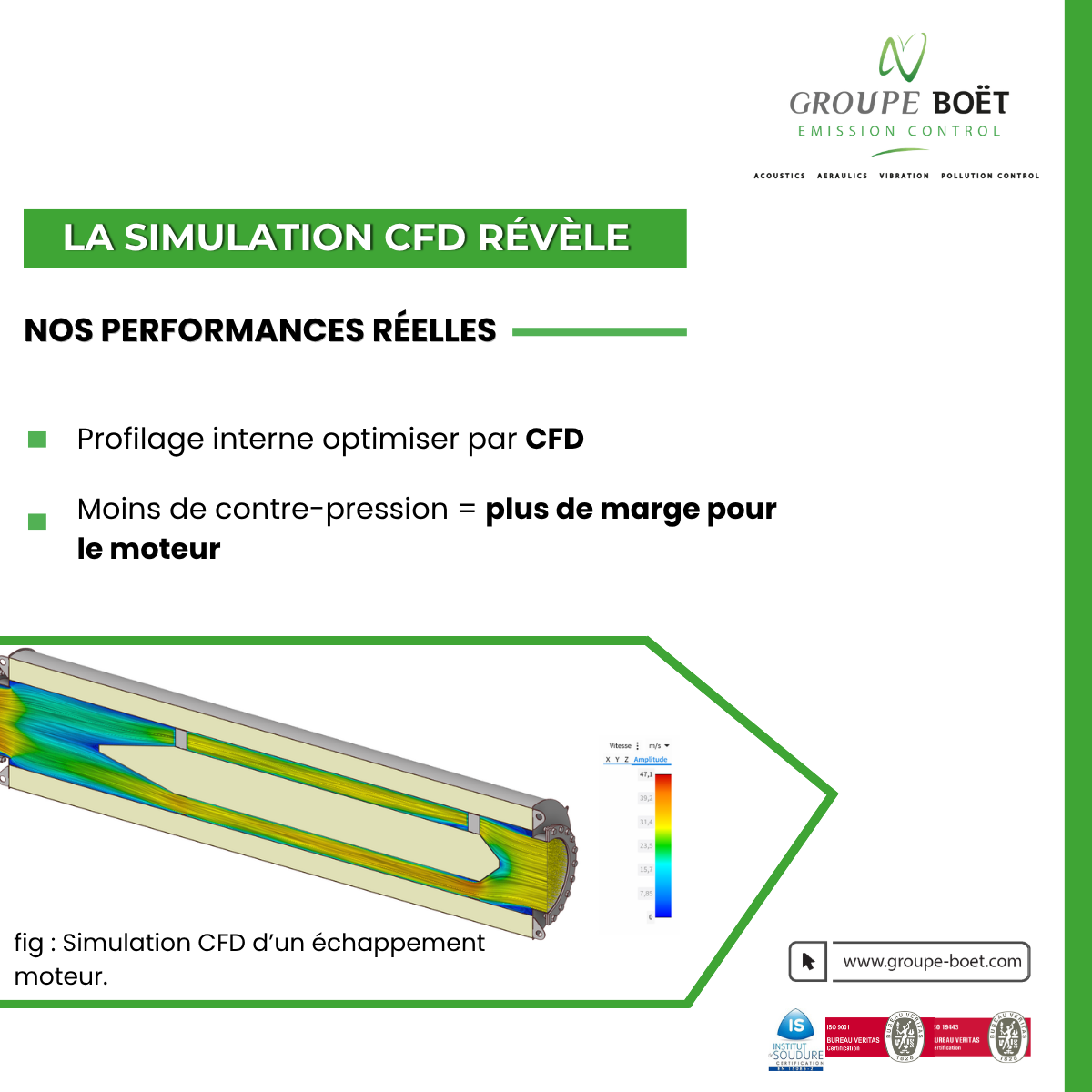
CFD (Computational Fluid Dynamics) simulation calculates the gas flow through the muffler and quantifies its pressure drop prior to manufacturing. The geometry is adjusted on the drawing board, rather than after an overshoot is detected during startup.
Velocity and pressure maps show where the gas accelerates, where it separates from the walls, and where it recirculates. These are the areas where pressure drop is concentrated. The designer then adjusts the cross-sectional transitions, the inlet profiles, or the shape of internal components, and verifies the effect of each modification on the calculated pressure drop.
At the Groupe Boët, CFD is performed using Ansys Fluent and supplemented by finite element analysis (FEA) to assess mechanical and acoustic behavior. These tools have been validated on a test bench. We detail this approach in our article on numerical simulation and the design of industrial silencers.
For you, pressure drop becomes an input parameter in the quote, rather than a risk deferred until commissioning.
SM EVO 2: An Exhaust Silencer Optimized Using CFD
The SM EVO 2 is our next-generation engine exhaust silencer. Its internal profile, optimized using CFD, minimizes restriction zones and controls pressure drop, while meeting the required acoustic specifications.
An internal design that provides headroom
The internal geometry was designed to guide the flow rather than restrict it. Controlled pressure drop provides headroom for the engine or for an aftertreatment system located downstream. This is important whenever an SCR (Selective Catalytic Reduction) catalyst is part of the system: it, too, consumes a portion of the backpressure budget. That is why we design the muffler and the engine’s emission control system as a single unit.
Reduced weight and footprint
The SM EVO 2 has been made lighter and more compact. Its reduced weight puts less strain on the mounts and the structure supporting them. Its smaller footprint frees up space inside an enclosure or container, where installation is constrained by the rest of the equipment.
Dimensions validated in advance
Flow is simulated and pressure drop is anticipated prior to manufacturing, rather than observed during startup. The SM EVO 2 is available in three attenuation classes— 30, 40, and 50 dB(A)—and its design has been validated through laboratory and field testing. The goal: to meet acoustic specifications while keeping backpressure below the manufacturer’s limit, without any power loss that needs to be compensated for.
The SM EVO 2 serves as the foundation of our engine exhaust silencers lineup. Its specifications are detailed in the SM EVO 2 engine exhaust silencer data sheet.
From prototype to production: consistent performance across every unit
For a manufacturer of engines or generator sets, the back pressure validated on a prototype is only meaningful if every production unit reproduces it. This requires a standardized design, manufactured and inspected by the same team.
Pressure drop depends directly on the internal geometry: flow cross-sections, the position of internal components, and the quality of the connections. The SM EVO 2 is manufactured in France at our facility in Tourcoing, where the design office, fabrication shop, and quality control department are all located under one roof. The process from design to finished product is handled by the same team throughout.
We are ISO 9001 and ISO 19443 certified, and our welding is EN 15085-2 certified. For a new engine program or a new line of power units, integrating the muffler from the design phase (design-in) allows the backpressure budget to be allocated among the components before the design is finalized.
Back Pressure from an Exhaust Muffler: Key Takeaways
The back pressure of an exhaust silencer is calculated; it cannot be observed during commissioning. Low-frequency attenuation and pressure drop stem from the same physical phenomenon, which CFD simulation allows us to optimize during the design phase. With the SM EVO 2, the Groupe Boët applies this method to a mass-produced silencer, ensuring identical performance across every unit.
Are you integrating an exhaust silencer into a range of engines or generator sets? Our engineers will analyze your backpressure budget and acoustic specifications: contact the Groupe Boët.