
Introduction
But this amounts to accepting approximate performance—validated after the fact through costly corrective testing—in environments where there is zero margin for error. For projects subject to strict building codes, contractual acoustic performance commitments, and tight commissioning deadlines, empirical iteration is not a method—it is a risk. Numerical simulation has changed the nature of this risk.
The Limitations of the Empirical Approach in Industrial Acoustics
For decades, industrial acoustic design relied on charts, empirical rules derived from field experience, and cycles of physical iteration: equipment was manufactured, tested, discrepancies were identified, corrections were made, and the equipment was remanufactured. This method produced effective equipment. However, it has structural limitations that become insurmountable in projects subject to strict regulatory constraints.
A physical iteration cycle consumes manufacturing time, testing resources, and involves non-negotiable deadlines. On a nuclear or energy project, each round trip between the design office and the workshop can take several weeks. If nonconformities are detected only upon on-site acceptance, the additional costs can be substantial—and the commissioning schedule is compromised. Numerical simulation makes it possible to anticipate these nonconformities as early as the design phase, before the first sheet of metal is cut.
FEA: Modeling Mechanical and Acoustic Behavior
Finite Element Analysis (FEA) models the mechanical and acoustic behavior of the silencer’s structure. It allows us to calculate the stress distribution under the pressure, temperature, and vibration loads specific to each application, and to verify the mechanical integrity of the equipment under actual operating conditions.
From an acoustic standpoint, FEA makes it possible to identify the structure’s natural modes—that is, the frequencies at which it naturally resonates—and to compare them to the harmonics of the machine being analyzed. A coincidence between a natural mode of the compressor silencer or engine silencer and an excitation frequency from the source can cause sound amplification that partially negates the intended attenuation. FEA detects this risk during the design phase, allowing the geometry or materials to be modified before manufacturing.
CFD: Optimizing Internal Flow and Pressure Drop
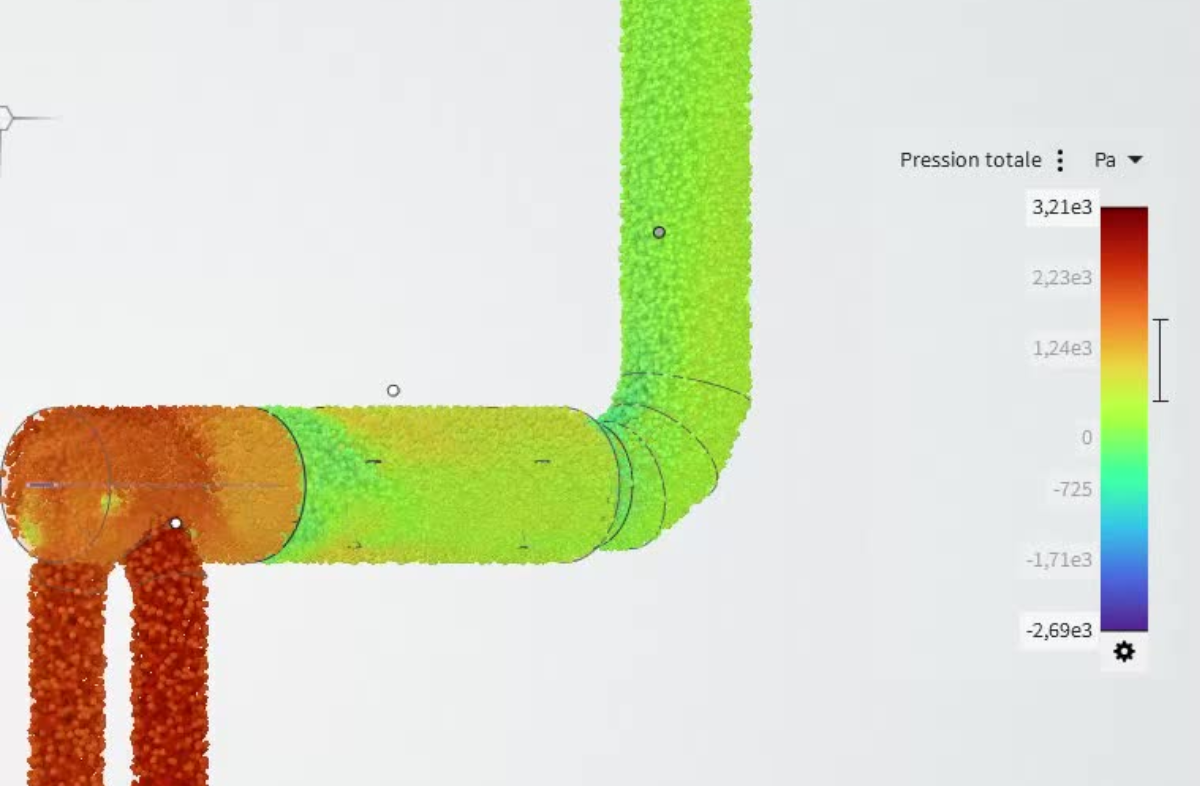
The CFD ( Computational Fluid Dynamics) simulation—performed using Ansys Fluent—models the gas flow inside the muffler. It allows for the visualization of velocity distributions, areas of separation, internal turbulence, and pressure gradients that cause pressure drops.
For a blower silencer or an industrial ventilation silencer, allowable pressure drops are often just as restrictive as acoustic requirements. Equipment with excessive resistance reduces the efficiency of the upstream machine and can compromise the system’s energy balance. CFD enables the optimization of internal geometries—baffle profiles, inlet and outlet shapes, and flow channel layouts—to reduce pressure drops without compromising sound attenuation. This trade-off, which is difficult to achieve through analytical calculation alone, can be achieved through simulation in just a few numerical iterations.
Modal Analysis: Anticipating Resonance Risks
Modal analysis complements FEA. It identifies all the natural modes of the silencer structure—resonance frequencies, modal shapes, and damping factors—and allows for the mapping of the equipment’s vibration-sensitive areas. This analysis is particularly useful for mufflers installed on machines with variable speeds, whose excitation spectrum spans a wide range of frequencies during startup and shutdown.
What visual inspection and empirical calculations cannot detect, modal simulation reveals. A geometry that appears correct may exhibit a problematic natural mode at a recurring excitation frequency of the machine. Identifying this risk before manufacturing avoids structural modifications during construction, which are always more costly than making adjustments during the design phase.
A Qualified Simulation on a Test Bench at the Groupe Boët
As early as the 1970s, the Groupe Boët developed acoustic and aerodynamic simulation tools, at a time when available computational resources were still very limited. This pioneering approach laid the foundation for a culture of continuous R&D, which has evolved over the decades alongside advances in digital technology.
Today, the simulation tools used by the Groupe Boët’s teams—FEA, Ansys Fluent CFD, and modal analysis—were validated on static and dynamic test benches. Simulation predicts performance; physical testing confirms it. This validation loop ensures that the numerical models accurately reflect the actual behavior of the equipment and that the performance specifications established during the design phase are actually achieved upon delivery.
The industrial acoustic equipment designed by the Groupe Boët complies with the EN 15085, ASME, RCC-M, CODAP, and CODETI standards, within the framework of a management system certified to ISO 9001 and ISO 19443. For any project with strict acoustic and regulatory requirements— compressor silencers, engine silencers, blower silencers, Acoustic enclosures, or custom acoustic protection —the Groupe Boët’s R&D teams can be reached at www.groupe-boet.com. See also the article on the spectral sizing of silencers to learn more about the frequency analysis method applied prior to simulation.