
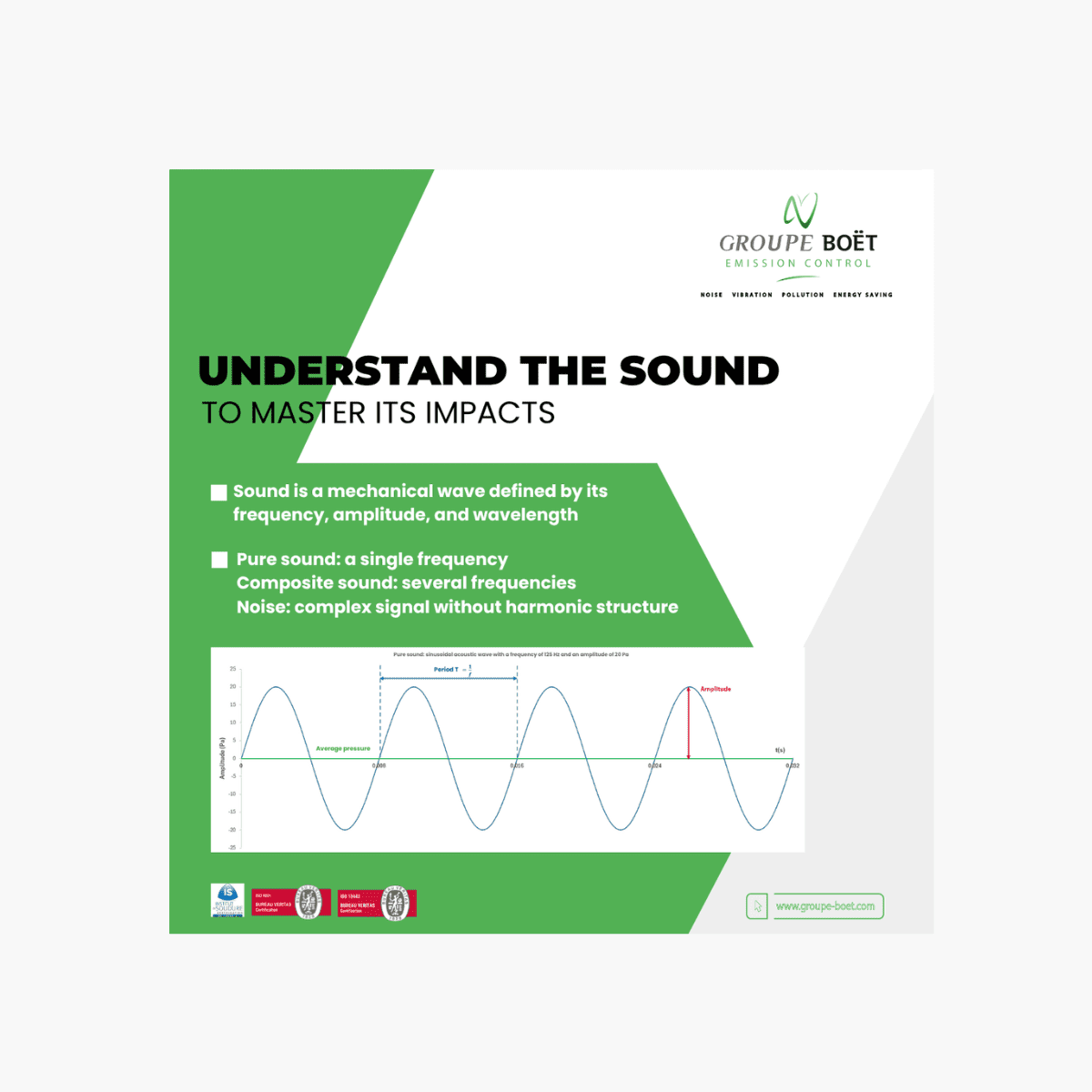
Understanding sound to control its impact
In industrial environments, noise is more than just an annoyance. It affects safety, machine performance and regulatory compliance. For Groupe BOËT, experts in acoustic solutions, understanding the nature of sound is the first step in effective noise control, because every project is based on a detailed understanding of sound phenomena.
What is sound?
As you read this article, you may be aware of sounds: the hum of an air conditioner, a distant conversation, or city traffic. These signals, whether pervasive or imperceptible, are actually mechanical waves. Sound propagates via microscopic collisions between particles: one molecule pushes the next, without transporting matter. Each molecule oscillates around its own position, causing a variation in pressure around an average pressure.
How do you describe a sound?
Frequency
Frequency, expressed in hertz (Hz), indicates whether a sound is low or high-pitched. The human ear perceives frequencies from 20 Hz to 20 kHz. This information is essential for the acoustic dimensioning of acoustic enclosures, acoustic grilles or acoustic panels.
Wavelength
The wavelength (λ) corresponds to the distance covered by the sound wave during one period :
λ=cfλ = frac{c}{f}
-
λ: wavelength (meters)
-
c: speed of sound (≈ 343 m/s)
-
f : frequency (Hz)
Amplitude and decibels
Soundamplitude represents a variation in pressure. Expressed in pascals (Pa), it ranges from 20 µPa (hearing threshold) to 200 Pa (pain threshold). As this scale is not very intuitive, decibels (dB) are used:
Lp = 20 – log₁₀(p / p₀)
With p₀ = 20 μPa, hearing threshold at 1 kHz.
Here are a few useful pointers:
-
0 dB: hearing threshold
-
60 dB: conversation
-
85 dB: regulatory threshold
-
120 dB: pain
-
140 dB: aircraft on take-off
💡 +20 dB = x10 in pressure
From pure sound to noise
A pure sound is a sinusoidal wave of a single frequency. But acoustic reality is more complex: sounds are composed of multiple frequencies, like a piano note combining fundamentals and harmonics.
Noise, on the other hand, is characterized by its lack of clear harmonic structure, which often makes it unpleasant. Yet it can be useful:
-
for detecting leaks or mechanical faults,
-
for specific applications (e.g. pink noise used to promote sleep).
Turning noise into a performance driver
Thanks to its expertise in industrial acoustics, the Groupe BOËT transforms every noise problem into an opportunity for performance and compliance. Our know-how adapts to the most demanding requirements.
🎯 ISO 9001, ISO 19443, EN 15085, ASME, RCC-M, CODAP, CODETI certified operations.
📩 To find out more: Contact Groupe Boët – Request Information & Quotation