
Summary
- Back Pressure: A Limit Set by the Engine Manufacturer
- Two Suppliers, Two Margins, One Budget
- Positioning the SCR Based on Thermal Requirements, Not Available Space
- A Catalyst That Also Attenuates Noise
- Our Method: The Exhaust System Sized as a Single Unit
Back Pressure: A Limit Set by the Engine Manufacturer
Back pressure is the resistance the exhaust system opposes to gas flow. The engine manufacturer sets a maximum value: exceeding it takes the engine outside its guaranteed operating conditions.
Each component consumes a portion of this limit through its pressure drop: the oxidation catalyst, the SCR, the particulate filter, the silencer, but also elbows and pipe length. Total back pressure is the sum of these losses, measured at the engine outlet.
When this sum exceeds the limit, the engine pays the price: increased fuel consumption, degraded efficiency, and voided engine warranty. The phenomenon in detail for a silencer, and how to size it before manufacturing, is covered in our article on exhaust silencer back pressure.
Two Suppliers, Two Margins, One Budget
When emission control and acoustics are entrusted to two successive suppliers, each takes their margin on their component. The margins add up, while the back pressure budget exists only once.
Each supplier adheres to their specifications. The emission control supplier guarantees their conversion rates, the acoustic supplier guarantees their attenuation, and each protects themselves with a comfortable pressure drop on their own equipment. No one is responsible for the sum.
The exceedance appears when the complete line is operational, once both lots have been delivered. At this stage, correction is costly: it requires re-working an already manufactured component or accepting an engine operating outside its limit. The decision is therefore made earlier, at the time of project lotting.
Positioning the SCR Based on Thermal Requirements, Not Available Space
Selective Catalytic Reduction (SCR) only converts nitrogen oxides (NOx) within a specific temperature window. The catalyst is therefore placed first where gases are hot enough, not where space is available.
The SCR principle: a urea solution is injected into the gases, decomposes into ammonia, then reacts with NOx on the catalyst to form nitrogen and water. If the gases are too cold at the catalyst inlet, conversion drops and the guaranteed performance is no longer achieved.
In a system designed in two lots, the catalyst often inherits the space left free by the silencer, sometimes downstream, where gases have already lost some of their temperature. In a system designed as a single unit, the order is reversed: the catalyst position is determined by thermal requirements, and the acoustic volume is organized around it. Our approach to diesel and gas engine emission control details the technologies involved.
A Catalyst That Also Attenuates Noise
A catalyst is not just a chemical reactor: it also attenuates part of the exhaust noise. When included in the acoustic balance, it reduces the necessary silencer volume accordingly.
Its casing creates section changes, and its substrate forces gases through small-diameter channels. Both effects modify acoustic propagation in the line. If the catalyst and silencer are sized separately, this contribution is ignored: the silencer is calculated as if it had to handle everything alone.
Engine order frequencies, below 250 Hz, remain the silencer’s responsibility. But every decibel contributed by the catalyst means less silencer volume. For a containerized generator or a rooftop-installed system, this saved space is as important as performance.
Our Method: The Exhaust System Sized as a Single Unit
At GROUPE BOËT, the catalyst, filter, and silencer are calculated together, with a single margin placed correctly, within the limit set by the engine manufacturer.
Three choices structure this method:
- A single back pressure budget, distributed among components according to their role, instead of cumulative margins per supplier.
- A position determined by thermal requirements: the SCR is placed where gases allow the expected conversion.
- Components counted twice: the attenuation provided by the catalyst is included in the acoustic balance.
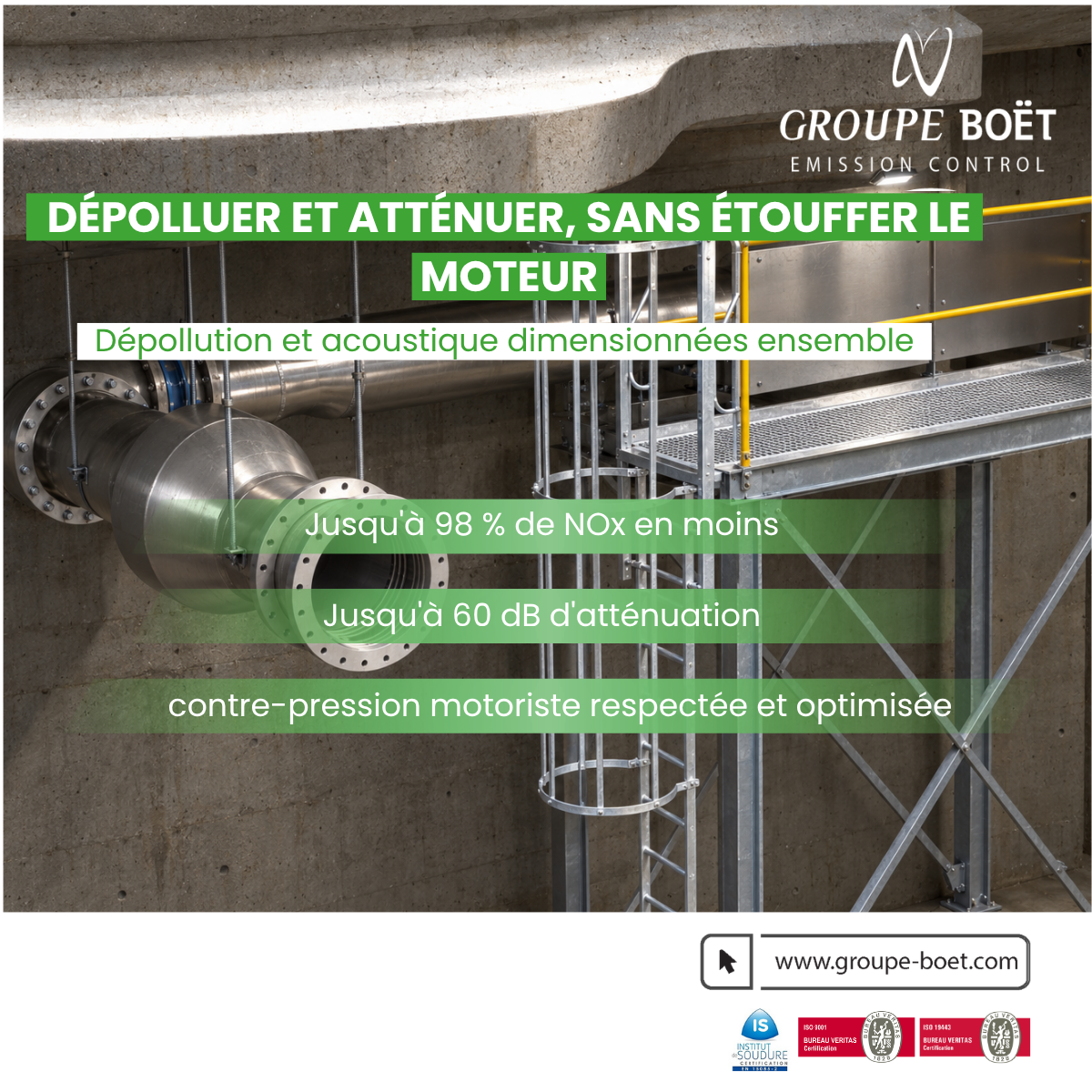
This method relies on our R&D team’s dual expertise in acoustics and emission control, and on the integrated boilermaking of our Tourcoing workshop, which allows us to size and then manufacture the system as a single unit. Depending on the configuration, it achieves up to 98% NOx reduction and 60 dB attenuation, without increased fuel consumption and with reduced footprint.
The regulatory framework varies depending on the installation: European Stage V regulation (EU 2016/1628) for non-road mobile machinery engines, MCPD directive (EU 2015/2193) for medium combustion plants. In both cases, emission compliance must not come at the cost of back pressure. GROUPE BOËT is ISO 9001 and ISO 19443 certified.
Conclusion
A generator exhaust system has only one back pressure budget. Sharing it between two suppliers means accepting that margins will stack up and the engine will pay the difference. Sizing it as a single unit allows for positioning the SCR based on thermal requirements, accounting for catalyst attenuation, and adhering to the engine manufacturer’s limit. One system, one party responsible for the result.
A Stage V project or MCPD compliance? Let’s discuss it before lot allocation.