
Introduction
In residential areas, the installation of rooftop heat pumps involves more than just complying with technical installation standards. Noise emissions from this equipment (compressors, fans, vibrations) generate noise levels that must remain within strict limits: 5 dB(A) during the day and 3 dB(A) at night. Exceeding these limits exposes the project owner to complaints from neighbors and an obligation to bring the system into compliance while the site is occupied, without the option of shutting down the equipment. The Groupe Boët intervened in Colombes to address precisely this situation.
Noise Emissions from Roof-Mounted Heat Pumps: What the Regulations Require
The regulations governing noisy facilities in residential areas establish noise emission thresholds expressed as the difference between the residual ambient noise level and the ambient noise level when the equipment is in operation. These thresholds—5 dB(A) during the day and 3 dB(A) at night—apply regardless of whether installation guidelines are followed. A heat pump installed in accordance with the manufacturer’s recommendations may still generate noise levels that exceed regulatory limits, depending on the site’s acoustic conditions.
In urban areas, controlling noise from rooftop HVAC equipment cannot therefore rely solely on technical installation guidelines. It requires a preliminary acoustic study, the design of noise-reduction measures tailored to the site, and verification through measurements after installation.
Colombes: A 20 dB(A) Exceedance at Night in a Residential Area
In Colombes, heat pumps installed on residential rooftops in accordance with best practices generated noise levels measured at +13 dB(A) during the day and +20 dB(A) at night. The difference from the regulatory thresholds—5 and 3 dB(A), respectively—is not insignificant. This exposed the project owner to complaints from neighbors, a formal notice, and an obligation to bring the system into compliance at an occupied site, without the possibility of shutting down or damaging the equipment while it was in operation.
The challenge entrusted to the Groupe Boët involved rectifying this situation after installation, within a roof space constrained by the existing parapets, existing piping, and the regulations of the Local Urban Planning Plan (PLU), while preserving the open-air spaces essential for the heat pumps’ thermal performance.
Solution: Four-sided acoustic enclosure designed to meet real-world requirements
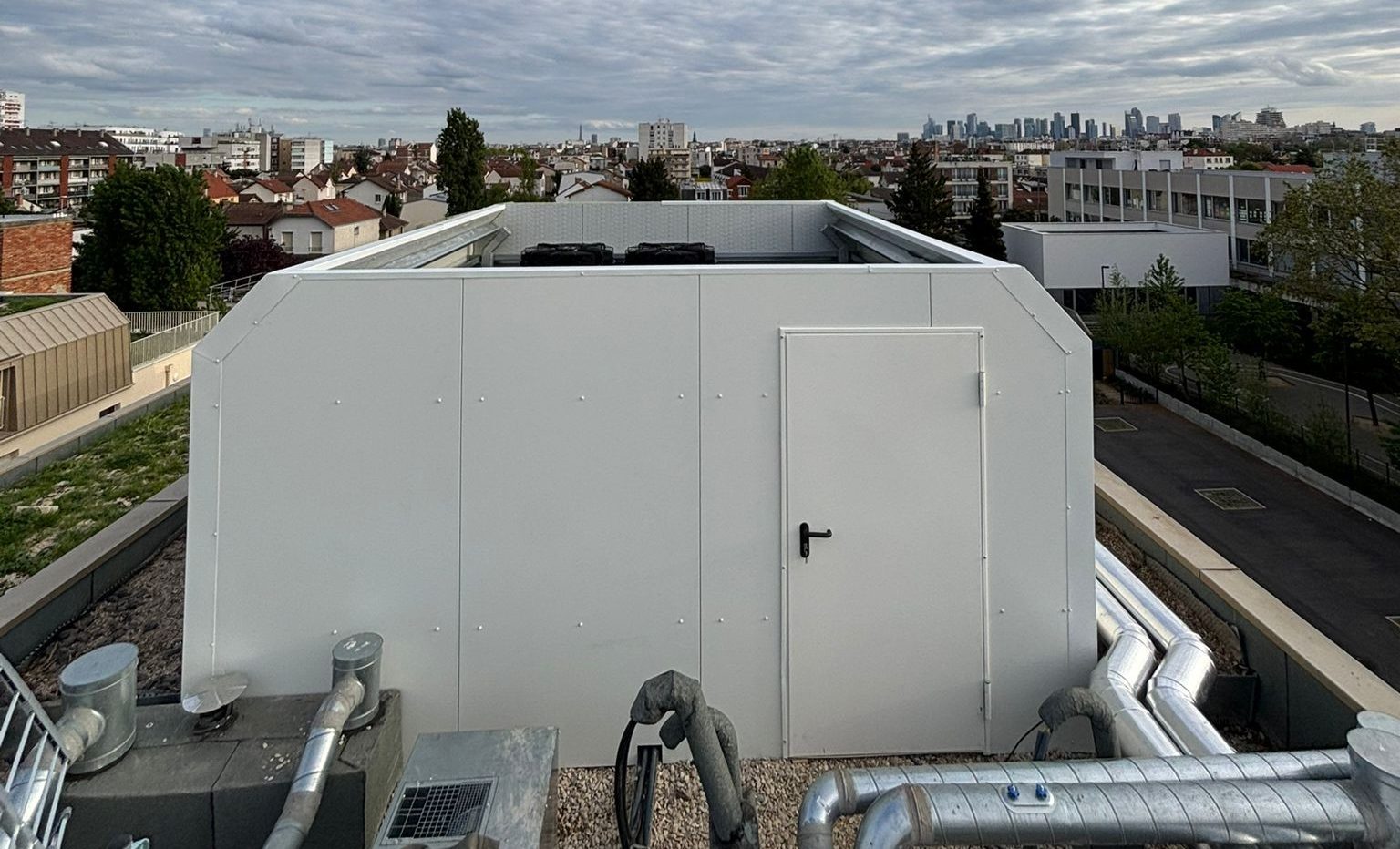
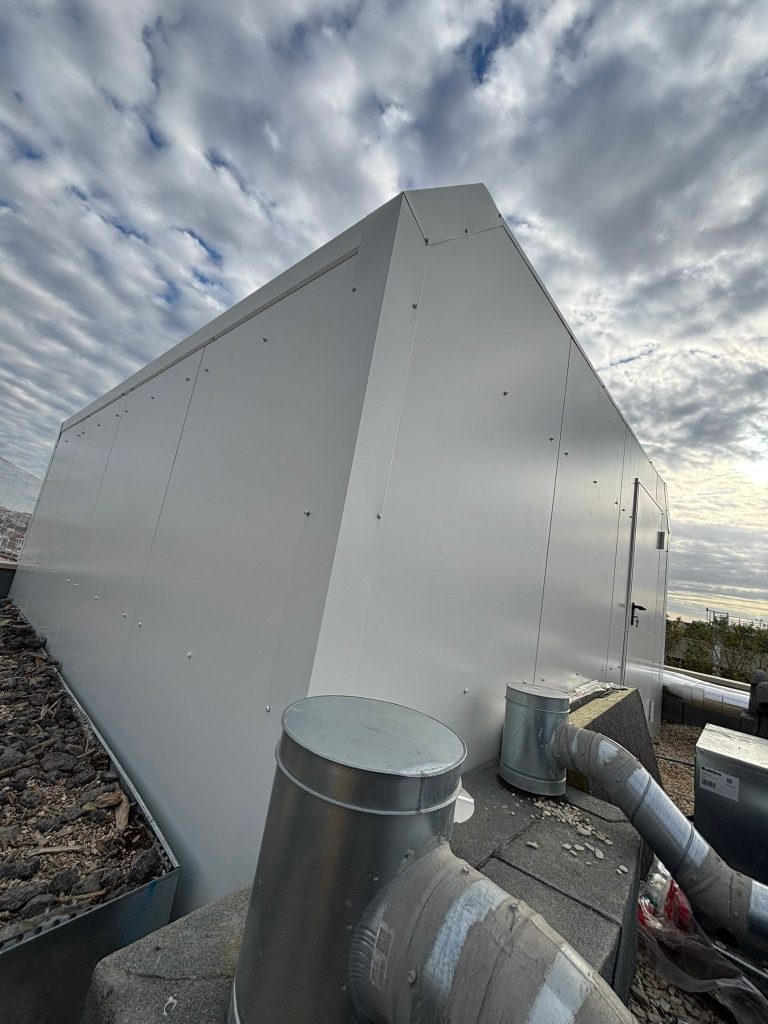
The Groupe Boët has developed a custom-made, four-sided acoustic enclosure that simultaneously meets the requirements for noise attenuation, airflow performance, and architectural integration. The solution is based on 100-mm BSP acoustic panels that combine wall attenuation (Rw) and internal absorption (αw) to address both sound transmission through the walls and reverberation inside the enclosure.
Specific treatment of low frequencies in the 63–250 Hz range was incorporated into the design. This range is critical for heat pump compressors and is precisely the range that is most difficult to attenuate using wall mass alone. The enclosure’s geometry has been optimized to limit the three identified residual propagation paths: direct transmission through the panels, internal reflections amplified by the geometry, and diffraction at the wall edges.
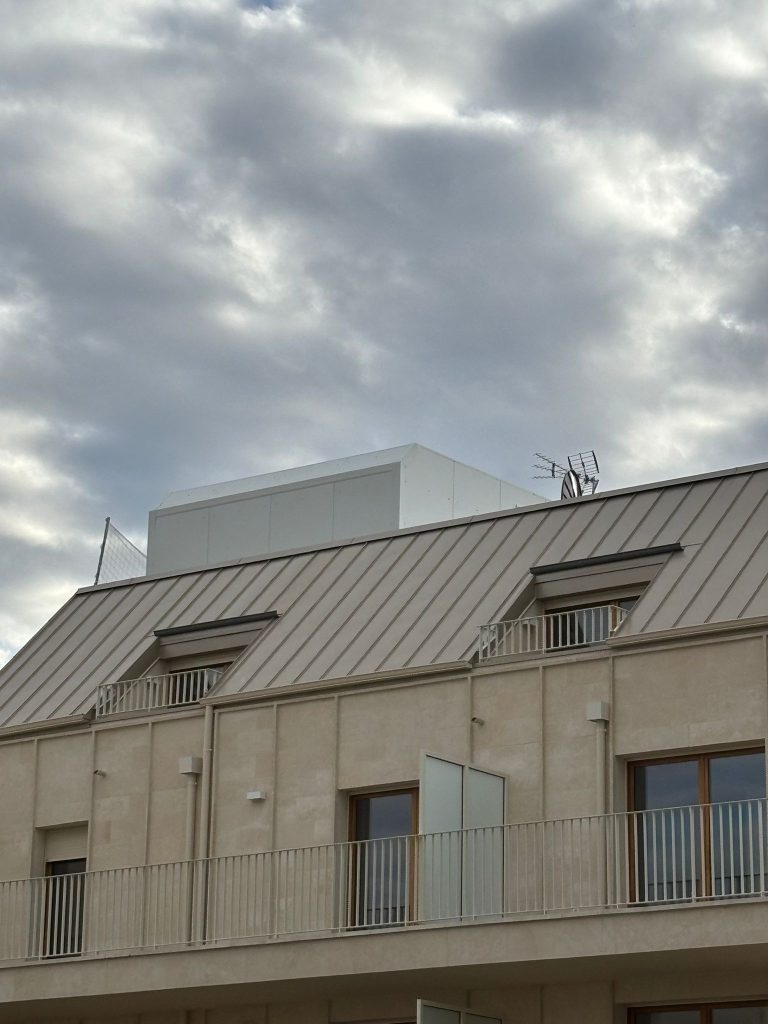
A built-in acoustic door provides access for maintenance without compromising the enclosure’s overall acoustic performance. The architectural integration was carried out in accordance with the local zoning regulations applicable to the site, enabling the Group to obtain the required architectural approval. The Groupe Boët relies on in-house manufacturing certified to ISO 9001 and ISO 19443.
Measured Results and Regulatory Compliance Achieved
Measurements taken after installation confirm that nighttime noise levels are now below the regulatory threshold of 3 dB(A). The thermal performance of the heat pumps remains fully intact: no reduction in airflow rates was observed. Architectural approval has been obtained. The entire project was carried out while the facility was in operation, from the initial acoustic analysis through the final acceptance measurements, without interrupting the operation of the systems.
This project illustrates a reality that is often underestimated in residential settings: compliance with technical installation guidelines is no substitute for a site-specific acoustic study. In residential areas, noise levels must be calculated, simulated, and verified before installation.
Assessment, Design, and Acceptance: An Integrated Approach
The Groupe Boët provides services for noise abatement projects in residential areas, from the initial planning phase through to final acceptance: acoustic assessment, numerical simulation, manufacturing of acoustic equipment in France, installation, and performance testing. For any project involving acoustic compliance for rooftop HVAC or heat pump systems, contact the Groupe Boët for a site analysis and a solution tailored to your specific requirements.