
Generator set exhaust line: in Milan, 94% NOx reduction targeted without an oxidation catalyst
Project underway · acceptance testing to come
In Milan, two 3,000 kVA backup generator sets must meet strict contractual targets: 94% NOx conversion, 50% CO reduction, and 73 dB(A) at 7 m. The available space left no room for the diesel oxidation catalyst (DOC) typically used to treat CO. Our teams designed two complete exhaust lines with SCR treatment, without this component. Acceptance testing is scheduled for the coming weeks.
The contractual targets:
- NOx conversion: 94%;
- CO reduction: 50%;
- NOx emissions: 100 mg/Nm³ at 15% O₂;
- noise level: 73 dB(A) at 7 m.
The challenge: meeting the CO target with no room for an oxidation catalyst
On this type of installation, CO is typically treated by a diesel oxidation catalyst (DOC) placed upstream of the SCR. Here, the space available in the room did not allow for its integration.
The constraint was addressed during the design phase, when the line’s architecture could still evolve. Our teams developed a different approach to meet the targets without this component.
The rest of the line had to fit within the same volume: SCR reactor, injection system, urea storage, and maintenance access. This called for a custom-designed skid, sized specifically for this installation.
What each exhaust line includes
Each generator set is fitted with a complete exhaust line that treats NOx, CO, and noise within a single assembly. The two lines are identical.
- SCR treatment. A urea solution is injected into the exhaust gases. As it decomposes, it releases ammonia, which reduces NOx into nitrogen and water vapor on contact with the catalyst. This mechanism is what delivers the 94% conversion target.
- AUS32 storage and injection systems. AUS32 is the 32.5% urea solution defined by ISO 22241. Storage and injection are part of our scope.
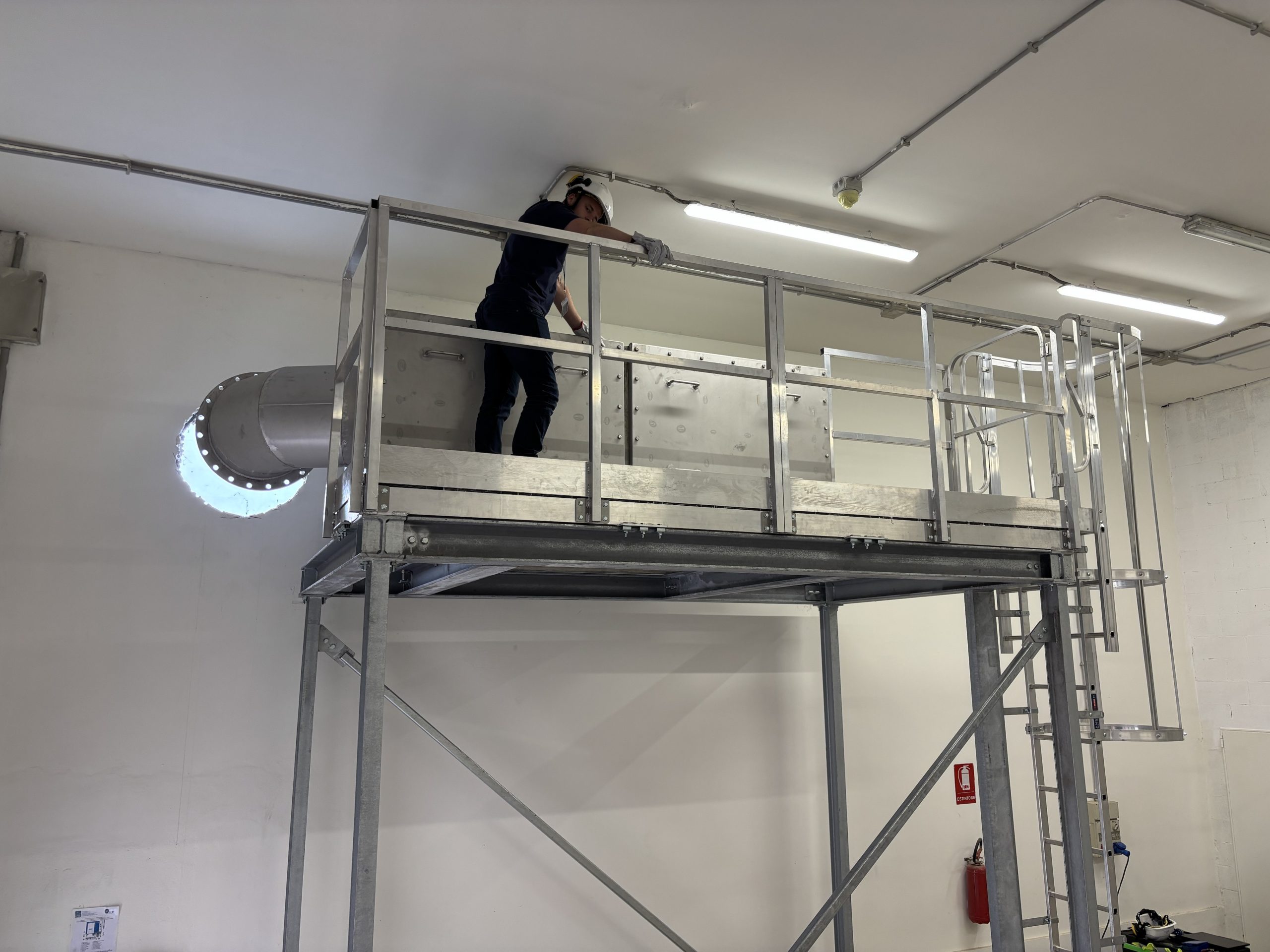
- Custom-designed skid. It supports the entire assembly and adapts it to the available space.
- Access structures. These provide access to the equipment for operation and maintenance.
The same line carries the acoustic target: 73 dB(A) at 7 m. Emissions treatment and noise attenuation are integrated into a single assembly, within the same constrained volume.
The 100 mg/Nm³ NOx target is expressed at 15% O₂. Normalizing the concentration to a reference oxygen content prevents dilution of the flue gases from making emissions appear lower than they actually are. 15% is the standard reference for engines.
Why a CFD study from the design stage
SCR conversion depends on how evenly flow and ammonia are distributed across the entire catalyst cross-section. An under-supplied zone lets NOx pass through; an over-supplied zone lets ammonia slip through.
In a compact line, bends and reduced sections can easily unbalance the flow. The CFD study conducted during the design phase validated flow distribution within the catalysts before any manufacturing began.
It also confirmed their performance under real operating conditions, particularly during start-up transients. A backup generator set goes from standstill to full load in a short time: during this phase, gas flow and temperature deviate from steady-state conditions. These are the conditions a backup generator set encounters every time it is called upon.
From Tourcoing to Milan, a single chain through to acceptance
Both lines were designed by our engineering office in Tourcoing and manufactured in our workshops. Our teams are overseeing the installation on site in Milan through to final acceptance.
For the client, this means a single point of contact, from design through to commissioning. Our ISO 9001 certification covers this entire scope: design, manufacturing, and installation.
Next step: acceptance testing and emissions measurements
Acceptance testing and emissions measurements are scheduled for the coming weeks. They will compare the measured values against the four contractual targets. We will publish the results on this page.
Are you integrating a generator set into a constrained space, with NOx, CO, and acoustic targets to meet? Our engineers size the complete exhaust line based on your installation. Let’s talk about your project
Frequently Asked Questions
What is AUS32? It is the 32.5% aqueous urea solution used in SCR systems, defined by ISO 22241. Injected into the exhaust, it supplies the ammonia that reduces NOx on the catalyst.
What does “100 mg/Nm³ at 15% O₂” mean? This is a NOx concentration normalized to standard temperature and pressure conditions, and to a reference oxygen content of 15%. This correction makes the value comparable across different installations.