
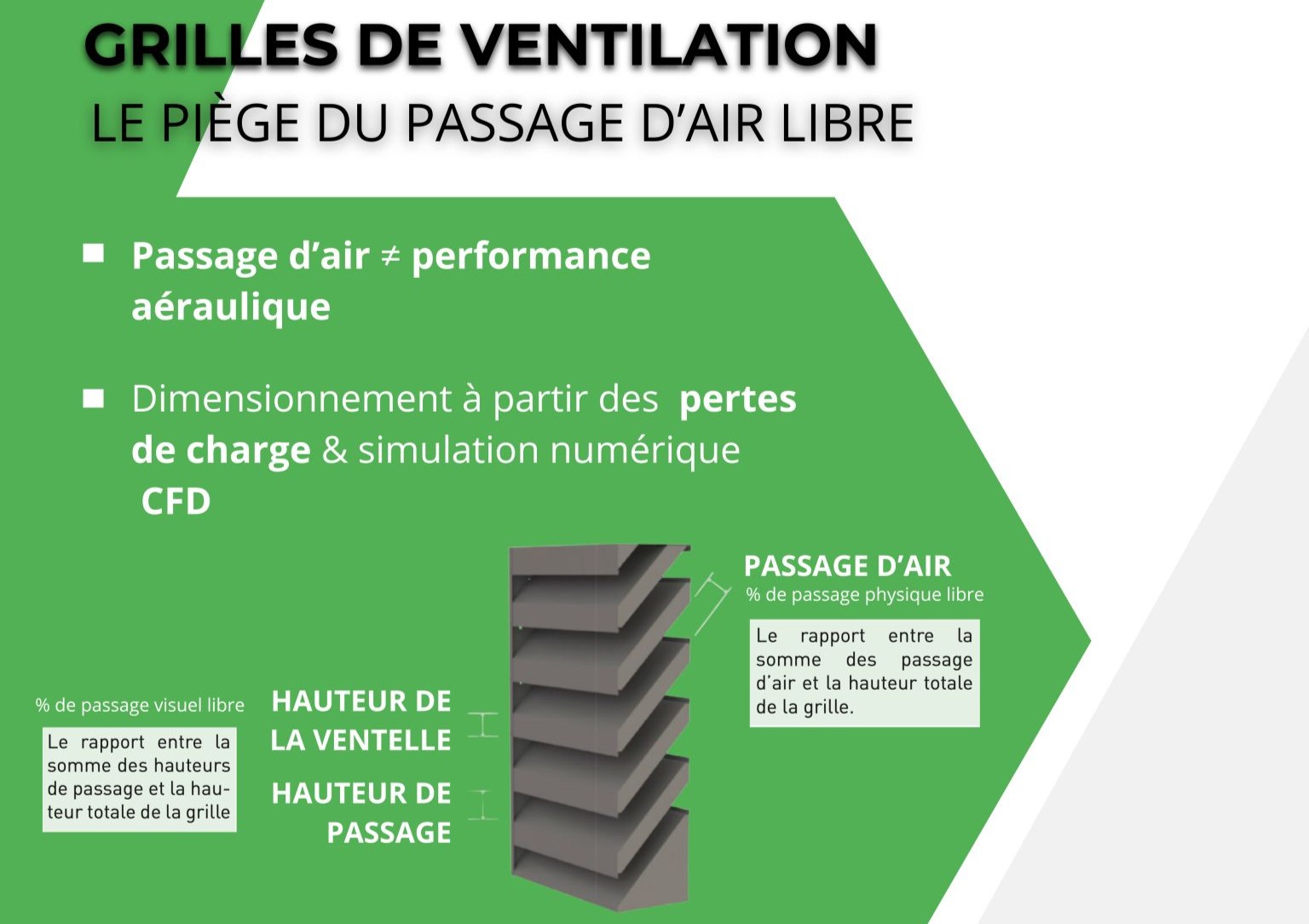
Industrial acoustic louvres: the “free air passage” trap
In industrial environments, controlling noise pollution has become a strategic challenge. Today, production sites, data centers, energy facilities, nuclear power plants and technical buildings must combine operational performance, regulatory compliance and acoustic comfort.
Noise control is no longer just a matter of adding insulating equipment. It is part of a genuine acoustic engineering approach, integrating industrial acoustic solutions, airflow calculations and operating constraints. Acoustic Louvers are a perfect illustration of this complexity, especially when they are designed solely on the misleading notion of “free air passage”.
- Introduction: the challenges of industrial acoustic grilles
- What is “free air passage” and why is it misleading?
- Aeraulics vs. acoustics: a complex technical equation
- Pressure loss ΔP: key performance indicator
- Conclusion
Understanding the myth of the free air passage
In aeraulics, what seems obvious is not always so. The percentage of air passage, whether visual or geometric, is often used as the main criterion for choosing a grille.
However, an acoustic grille dimensioned solely according to this value can generate excessive pressure losses. In some cases, admissible equipment thresholds – around 100 Pa for a cooling unit – are quickly exceeded.
The consequences are manifold: lower system efficiency, higher energy consumption, unbalanced air networks, premature mechanical malfunctions.
A visually large air passage therefore guarantees neither good flow nor lasting performance.
Airflow and acoustics: a complex technical equation
Conversely, a grille with a smaller air passage, but with optimized profiled blades, can deliver much better performance.
In a industrial acoustic treatment, the challenge is to find the right balance between :
- noise reduction,
- turbulence mitigation,
- maintaining flow rates,
- compliance with thermal constraints.
Industrial acoustic grilles therefore play a central role in overall site acoustic management. They are a key component of acoustic equipment such as acoustic enclosures, acoustic panels, acoustic doors or industrial silencers.

Pressure loss ΔP, a key performance indicator
The real aeraulic performance of a grille is not judged by its open area, but by its effective resistance to air flow: the pressure drop ΔP.
This is defined by the following relationship :
ΔP = K × (ρ/2) × V²
where :
- K is the pressure drop coefficient,
- ρ air density,
- V the flow velocity.
That’s why Groupe BOËT acoustic grilles acoustic louvres are designed exclusively on the basis of their K coefficient. This approach guarantees equipment that is predictable, stable in operation and perfectly compatible with the aeraulic constraints of the project.
Groupe BOËT’s expertise in noise reduction
To take this a step further, the Groupe Boët relies on a scientific approach based on CFD digital simulation (ANSYS / FLUENT).
R&D teams model the louvers precisely to optimize blade profiles, reduce turbulence, improve velocity distribution, and control the balance between acoustic and aeraulic performance.
This approach enables the design of acoustic louvers offering both high sound attenuation and controlled pressure drop, without compromising plant safety.
Performance is measured and certified, in compliance with the following standards and benchmarks: ISO 9001, ISO 19443, EN 15085, ASME, RCC-M, CODAP and CODETI.
At Groupe BOËT, acoustic performance is designed, simulated and measured.

Conclusion: long-term security for your industrial facilities
The design of an acoustic grille cannot be reduced to a simple percentage of air flow. Only a scientific approach, combining airflow control, acoustic technologies and field expertise, can ensure effective, lasting noise reduction.
For your industrial projects, Groupe Boët supports operators and design offices from needs analysis to final installation.
👉 Need an acoustic study or a personalized quote?
Contact the Groupe BOËT experts or discover other noise treatment solutions at www.groupe-boet.com.