
Summary
- Why the noise from a steam discharge is unforgiving of approximation
- The real cost of a precautionary margin
- Simulations qualified by testing
- An architecture that addresses noise starting from the lower section
- Our method: a steam atmospheric vent silencer guaranteed at the quotation stage
Why the noise from a steam discharge is unforgiving of approximation
The noise from a steam discharge increases very rapidly with jet velocity. For a subsonic jet, acoustic power varies as velocity to the 8th power: a small error in velocity becomes a large error in decibels.
This relationship, established by Lighthill’s law, has a direct consequence: a 10% increase in velocity produces about 3.3 dB of additional acoustic power. When the jet becomes supersonic, noise increases more slowly with velocity, but shock noise is added, linked to the shock cells that form within the jet.
A safety valve, a boiler start-up vent or a blowdown can release considerable levels: our VS atmospheric vent silencers handle sources up to 170 dB. At these levels, a modeling error is only discovered at the first discharge, once the silencer has already been installed.
The real cost of a precautionary margin
Without a reliable calculation, treatment is lengthened as a precaution. The operator then pays for unnecessary attenuation, and for the structure needed to support it.
An atmospheric vent silencer is most often a vertical piece of equipment, fitted at the outlet of a pipe. Every extra meter of height added as a precaution increases mass, and therefore support requirements, the loads transmitted to the structure or piping, and wind exposure. It also complicates transport and lifting on site.
The precautionary margin doesn’t appear in any specification, but it shows up in the overall cost of the installation. Removing it takes more than just a calculation: it requires a calculation whose accuracy has been demonstrated.
Simulations qualified by testing
Our expansion stages have been qualified by testing over a range of 100 to 600 t/h and 5 to 40 bar. These measurements were used to validate and refine our models, on which 15,000 simulations were subsequently conducted.
This test range covers common types of steam discharge. Simulations conducted on this basis ensure the accuracy of predictions for any new configuration, without oversizing as a precaution. Simulation predicts, testing confirms: it’s this combination that makes hidden margin unnecessary.
Our atmospheric vent silencer calculation models have also been validated at the world’s largest valve testing facility, at Framatome in Karlstein. They are developed by a multidisciplinary research and development team, which includes a PhD in acoustics and a PhD in fluid mechanics.
An architecture that addresses noise starting from the lower section
In the new VS generation, expansion, diffusion and initial attenuation are handled from the lower section of the silencer. An upper module is only added if the acoustic target requires it.
The principle is based on multi-stage acoustic expanders combined with a porous complex. Spreading the pressure drop across several stages limits jet velocity at each stage, which directly affects the noise source described by Lighthill’s law. Diffusion through numerous small orifices also shifts acoustic energy toward higher frequencies, which the porous complex absorbs effectively.
These diffuser stages operate under pressure: they are designed and manufactured in accordance with applicable construction codes, as detailed in our article on industrial silencer standards.
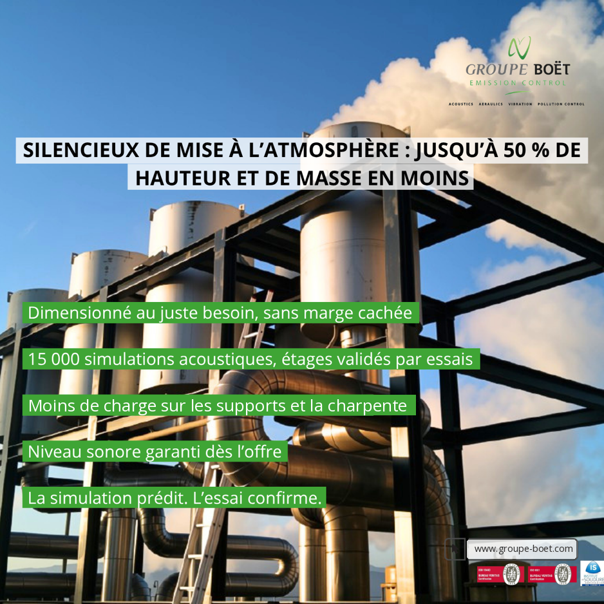
Result: up to 50% less height and 50% less mass compared to the previous generation, depending on configuration.
Example: saturated steam at 10 bar g
Case studied: saturated steam, 0.25 t/h, 10 bar g, target of 90 dB(A) at 1 m. The previous generation attenuated 5 dB(A) beyond the requirement. The new generation hits the target exactly, with 46% less height and 44% less mass.
That excess 5 dB(A) brought no benefit to the operator: it simply translated into extra height, steel and supporting structure.
Our method: a steam atmospheric vent silencer guaranteed at the quotation stage
At Groupe BOËT, the sound level of an atmospheric vent silencer is guaranteed from the quotation stage, based on a calculation qualified by testing, with no hidden margin.
In practice, sizing starts from your discharge data (flow rate, pressure, steam condition) and your acoustic target. The model determines the number of expansion stages and, only if needed, the upper module. You don’t pay in bulk for attenuation the project doesn’t require.
Design, manufacturing and inspection are carried out at our Tourcoing workshop. Groupe BOËT is ISO 9001 and ISO 19443 certified, and its silencers comply with the CODAP, CODETI and ASME codes depending on the installation.
Conclusion
On a steam atmospheric vent silencer, the precautionary margin doesn’t protect the operator: it costs them in height, mass and supporting structure. A calculation qualified by testing makes it possible to size to the actual requirement and guarantee the sound level from the quotation stage. This is what Groupe BOËT’s new VS generation delivers, with up to 50% less height and mass depending on configuration.
Have an atmospheric vent project, or an old VS file that needs re-evaluating? Our R&D experts are ready to help.