
Introduction
In industrial environments, sound insulation and sound absorption are all too often treated as synonyms. This confusion leads to costly design errors: partially effective treatments, non-compliant sound levels and persistent complaints.
However, these two approaches obey distinct physical laws, mobilize different materials and act on opposite sound phenomena. Knowing how to distinguish between them and how to combine them is a prerequisite for effective noise reduction in industrial environments.
Confusion with concrete consequences in the field
The trap is a classic one. A technical manager treats a noisy room with foam or mineral wool. The noise continues to spread to adjacent rooms and outwards. He has improved interior comfort, but not insulation. In the opposite case, a dense, airtight wall is installed without any sound-absorbing treatment inside the volume. The internal sound level rises as a result of the reverberation effect: the sound, finding no dissipative surface, bounces back indefinitely and accumulates.
In both cases, the result is identical: regulatory compliance not achieved, teams exposed to excessive noise levels and uncontrolled nuisance to the environment. The distinction between these two mechanisms is not a technical detail reserved for acousticians. It’s an operational prerequisite for any technical director or works manager involved in a noise abatement project.
Acoustic insulation: blocking sound transmission
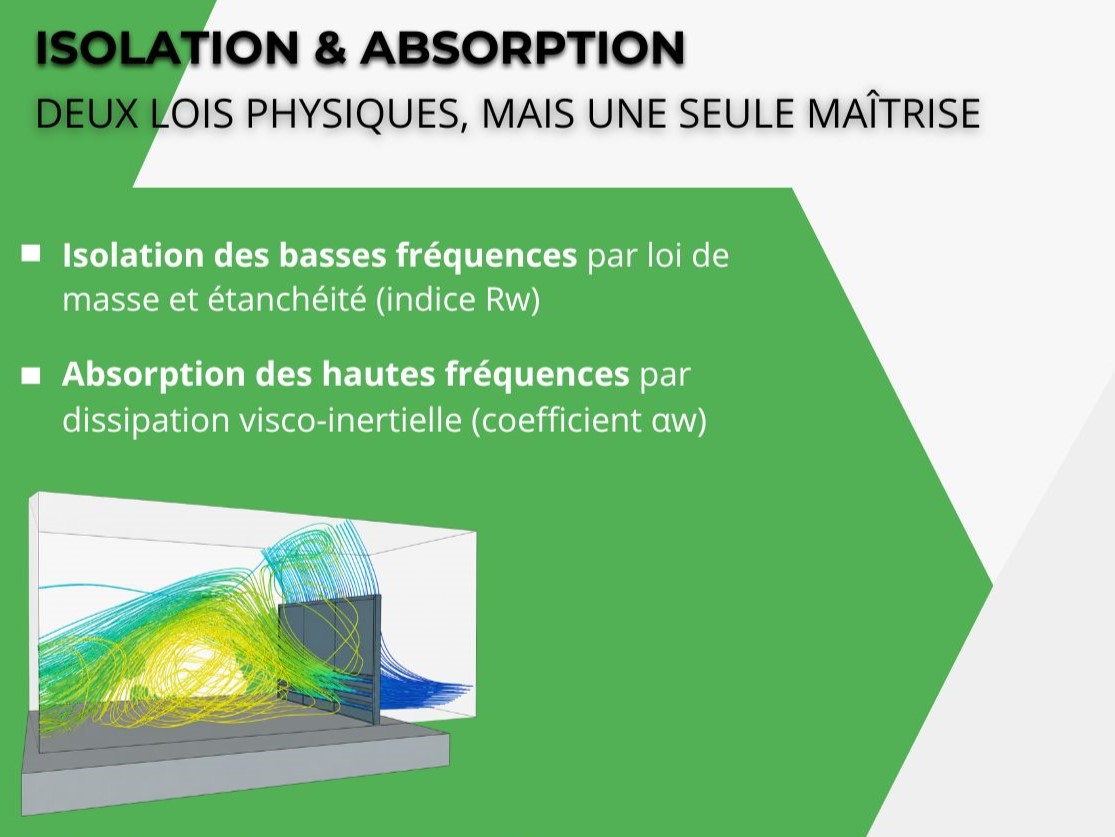
The aim of acoustic insulation is to prevent sound from passing through a wall. It responds to the law of mass: the heavier, denser and more continuous a wall, the greater its resistance to the vibration induced by the incident sound wave. The Rw sound reduction index, expressed in decibels, quantifies this capacity.
Effective insulating materials (concrete, steel, laminated glass, composite walls) are characterized by their high mass per unit area and the absence of discontinuities. A leak, a poorly installed joint or an untreated hole can cancel out a large part of the performance of even a well-dimensioned wall. This is why the design of a soundproof enclosure or acoustic cladding requires particular attention to singular points: cable penetrations, ventilation grilles, doors and access hatches.
Insulation protects neighbors and adjacent premises. It confines noise to its source. It does not reduce sound levels within the treated volume.
Sound absorption: dissipating internal sound energy
Acoustic absorption works differently. It does not block the transmission of sound through a wall. It reduces the sound energy reflected back into a space, converting some of this energy into heat. The absorption coefficient αw, between 0 and 1, measures this efficiency.
Acoustic absorption materials (mineral wool, synthetic fibers, open-cell foams) work by visco-inertial dissipation. When the sound wave penetrates the material’s porous structure, the oscillating movement of the fluid particles generates friction between the fluid and the material’s skeleton. This friction converts the wave’s kinetic energy into thermal energy. The resulting temperature is imperceptible, but the acoustic effect is measurable.
Acoustic panels, absorber modules and acoustic wall cladding reduce reverberation time and the average sound pressure level within a volume. They improve comfort and intelligibility, but do not protect adjacent spaces if the wall itself is not insulating.
Combining the two: the only complete answer
In most industrial situations, both mechanisms are required simultaneously. A compressor room generates a high level of noise, which must be contained to the outside (insulation) and prevented from accumulating inside to the detriment of those involved (absorption). To treat one without the other is to solve half the problem.
This combination also applies to basic acoustic equipment. An effective soundproof enclosure combines a dense, continuous outer shell for insulation, with an absorbent inner lining to limit reverberation inside the enclosure and improve its overall performance. A soundproof enclosure designed without internal treatment may exhibit resonances that degrade its attenuation in certain frequency ranges.
Groupe Boët solutions for industrial noise control
Groupe Boët designs industrial acoustic equipment that combines insulation and absorption in a single envelope. BSP-type metal panels are one example: their perforated surface coupled with a core of absorbent material blocks transmission while dissipating internal sound energy. Noise isn’t just stopped, it’s physically dissipated.
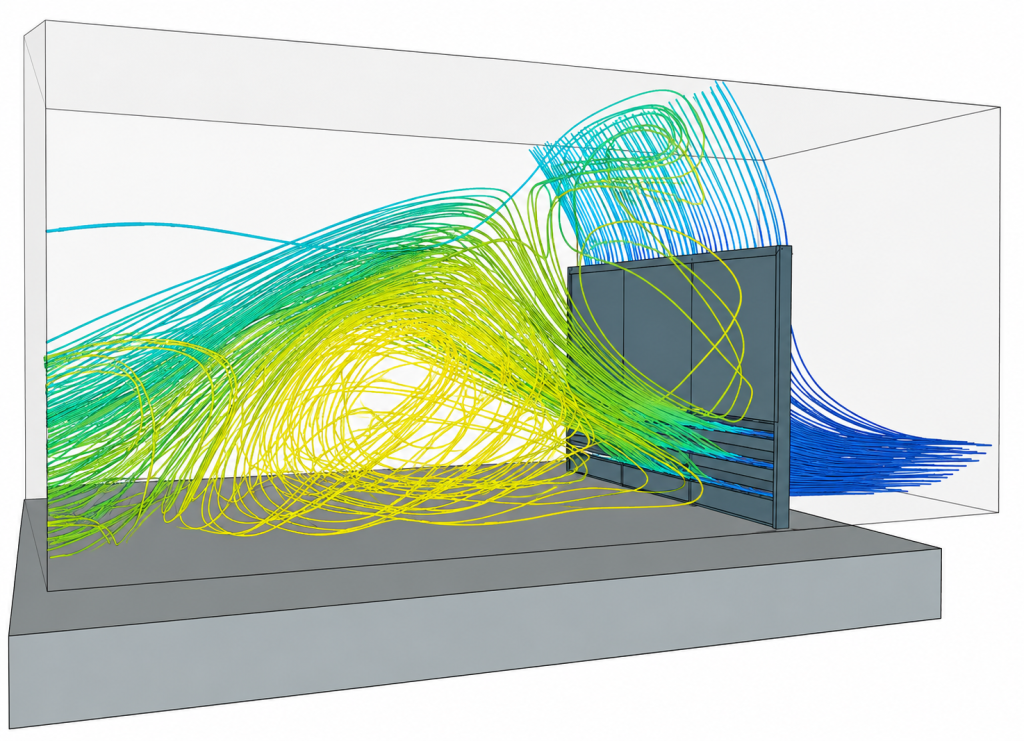
Groupe Boët R&D teams use digital simulation tools to model, predict and optimize each solution before manufacturing. This approach guarantees performance in line with objectives, without costly on-site iterations. The industrial acoustic solutions produced comply with ISO 9001 and ISO 19443 certifications, as well as EN 15085, ASME, RCC-M, CODAP and CODETI codes.
For any industrial noise reduction problem (noisy premises, point source with hood, facade or envelope treatment) Groupe Boët offers a preliminary technical analysis to select the insulation-absorption combination best suited to each configuration. Contact the Groupe Boët experts at www.groupe-boet.com to submit your problem and obtain a customized response.