
Introduction
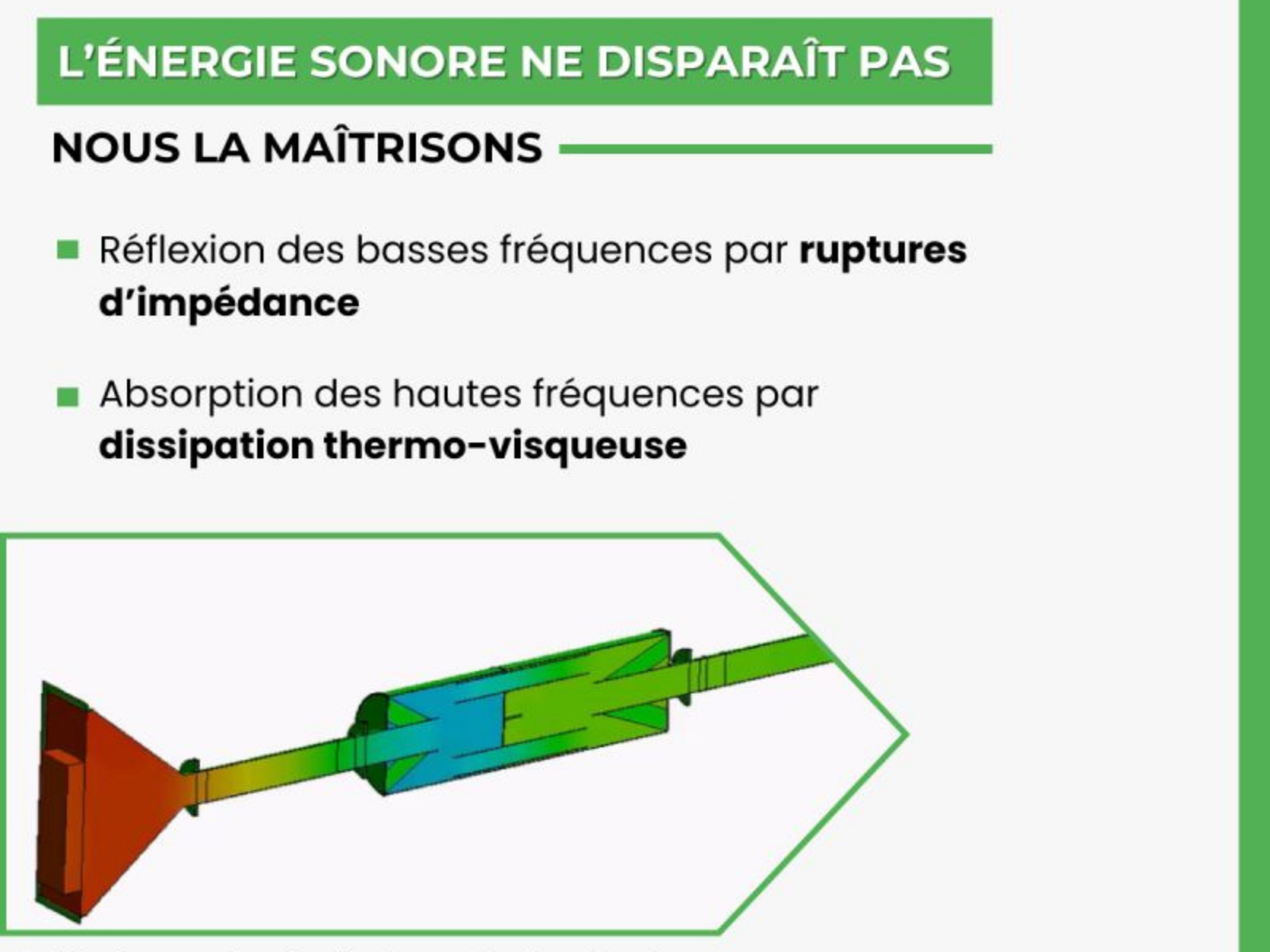
In acoustics, as in physics, nothing is lost. Sound energy is transformed. Understanding these transformation mechanisms is essential for choosing the right acoustic equipment, correctly sizing a noise reduction system, and anticipating the behavior of an installation in real-life conditions.
The sound wave: mechanical energy, not an abstract phenomenon
A sound wave is a form of mechanical energy. It propagates in a material medium – air, gas, industrial fluid – under the effect of vibrations that set the particles in the medium into oscillating motion. This energy manifests itself in two complementary forms that constantly coexist.
The first is kinetic energy, linked to the physical displacement of particles in the medium as they oscillate. The second is potential energy, associated with the pressure variations that occur during successive phases of compression and expansion of the fluid flowing through it. These two components transfer to each other as the fluid propagates, like a pendulum in motion.
It is precisely this mechanical nature of the sound wave that makes its treatment by acoustic equipment possible. An industrial silencer does not annihilate energy: it transforms it, redirects it or dissipates it, according to well-established physical principles.
Reactive attenuation: processing low frequencies
Low frequencies pose a particular challenge in industrial acoustics. Their wavelength is long, their energy is high, and conventional absorption materials have little effect on them. Reactive silencers – also known as expansion chamber silencers – are designed to meet this challenge.
Their principle is based on the creation of acoustic impedance breaks inside the silencer. When the sound wave encounters a sudden change in cross-section – between a narrow duct and a wide chamber, for example – some of the energy is reflected back upstream, towards the source. This reflected wave then interferes with the incident wave. If the dimensions of the silencer are calculated so that this interference is destructive, the two waves partially or totally cancel each other out in certain frequency ranges.
Sound energy is therefore not transmitted downstream. It is returned to the source and gradually dissipated by the system’s internal losses – walls, connections, turbulence. This mechanism is particularly effective on compressor silencers, booster silencers and low-frequency ventilation equipment, where the dominant spectral lines are below 500 Hz.
Dissipative attenuation: conversion to heat
For medium and high frequencies, the attenuation mechanism is fundamentally different. Dissipative silencers use porous absorbent materials – acoustic mineral wool, specific synthetic fibers – to convert sound energy into thermal energy.
This energy transfer operates through two simultaneous mechanisms. The first is mechanical dissipation: the material fibers vibrate under the effect of the acoustic field, dissipating energy through internal friction. The second is visco-inertial dissipation: the fluid oscillating in the material’s micropores generates viscous friction that converts the particles’ kinetic energy into heat.
The amount of energy converted into heat remains small in absolute terms – the rise in silencer temperature is imperceptible under normal operating conditions. But this conversion is sufficient to significantly reduce the sound pressure level radiated outwards. The sound-absorbing materials used in this type of equipment are selected for their absorption coefficient, and their resistance to humidity, temperature and the mechanical stresses typical of industrial environments.
Measurable performance in the field
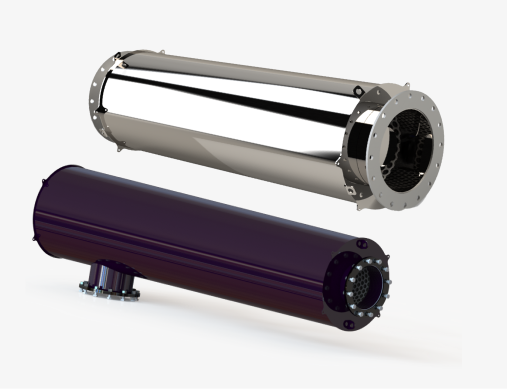
The combination of reactive and dissipative mechanisms in a single silencer – a so-called hybrid silencer – enables a wide frequency spectrum to be covered. It’s this ability to transform a physical phenomenon into measurable, site-verifiable performance that distinguishes well-designed acoustic equipment from a mere compliance accessory.
Choosing the right silencer for your sound spectrum
The choice between a reactive, dissipative or hybrid acoustic silencer depends directly on the spectral analysis of the noise source to be treated. An engine or exhaust silencer designed to treat an internal combustion engine at a fixed speed will have a spectrum dominated by low-frequency lines: the reactive solution will be preferred. A wide-spectrum ventilation system will lead to a dissipative or hybrid solution.
This preliminary analysis is essential. Poorly dimensioned equipment may achieve its objectives in certain frequency ranges, while remaining ineffective – or even counterproductive – in others. Industrial acoustic studies enable us to precisely characterize the source, define target levels and select the appropriate technology.
Groupe Boët’s expertise in industrial noise treatment
Groupe Boët designs and manufactures industrial silencers for demanding applications: energy, nuclear, petrochemical, data centers, heavy industry. Each piece of equipment is dimensioned on the basis of a rigorous acoustic analysis, taking into account the source spectrum, flow, pressure and temperature constraints, as well as applicable regulatory requirements.
The solutions developed by Groupe Boët – compressor silencers, booster silencers, engine silencers, suction and discharge silencers – comply with EN 15085, ASME, RCC-M, CODAP and CODETI standards. They are produced under an ISO 9001 and ISO 19443-certified quality management system.
Controlling noise in industrial environments requires a detailed understanding of the physical phenomena involved. Contact Groupe Boët to request an industrial acoustic study or a silencer sizing study adapted to your installation: www.groupe-boet.com. You can also consult our articles on acoustic enclosures and acoustic panels to discover the complementary solutions available.