
Introduction
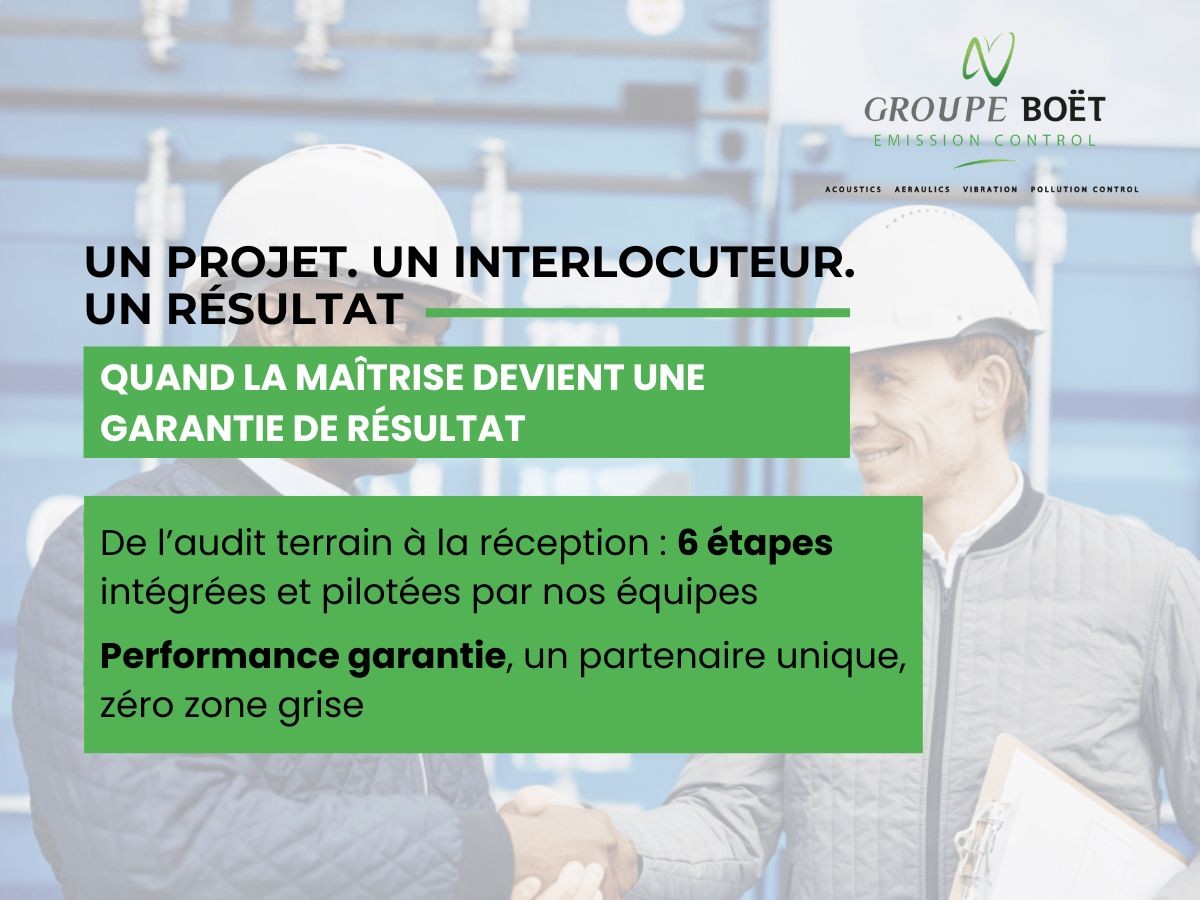
An industrial noise abatement project involves several disciplines: acoustic assessment, design, equipment manufacturing, on-site installation, and performance testing. When these steps are entrusted to separate contractors, each delivers its own part without an overview of the entire project. If performance targets are not met upon acceptance, identifying the cause—and assigning responsibility—becomes a lengthy and contentious process that delays compliance and brings the project to a standstill.
The large number of service providers: a risk that is often underestimated
A typical industrial acoustics project involves an acoustics engineer for the assessment, a manufacturer for the equipment, a contractor for installation, and, sometimes, an inspection firm for final validation. Each party is an expert in their own field, but none bears responsibility for the overall result. The interfaces between these parties are all potential points of friction: an assumption made by the acoustician that isn’t communicated to the manufacturer, a manufacturing tolerance that isn’t compatible with installation constraints, or an acceptance test that reveals a discrepancy without any party acknowledging its share of responsibility.
This fragmentation comes at a direct cost. Projects are delayed, non-conformities identified at the end of construction block delivery, and the search for liability among contractors can lead to litigation. For a technical director or construction manager, this risk affects the overall installation schedule and, in some cases, the commissioning of the facility.
Where Do Acoustic Nonconformities Actually Originate?
A poorly coordinated acoustic project doesn’t fail at the installation stage. It fails right from the design phase, when no one is taking overall responsibility. An industrial acoustic study that fails to take into account the actual constraints of manufacturing or installation produces specifications that are theoretically correct but difficult to achieve in practice. Conversely, manufacturing based on incomplete specifications may result in equipment that is perfectly built but unsuitable for the site’s actual configuration.
These discrepancies can only be identified during acceptance testing—which is too late to correct them without incurring additional costs or delays. Noise control at an industrial site is therefore not limited to selecting high-performance equipment. It depends on the consistency of the entire process, from the initial assessment through the final verification.
Managing an Acoustic Project from Start to Finish
An integrated approach involves entrusting the entire process to a single partner, organized into six well-defined stages. The on-site audit allows for a precise characterization of noise sources, their frequency spectrum, and their environment. The study and sizing phase define the target performance levels and the appropriate acoustic equipment — industrial silencers, Acoustic enclosures, acoustic panels, and acoustic grilles —as needed.
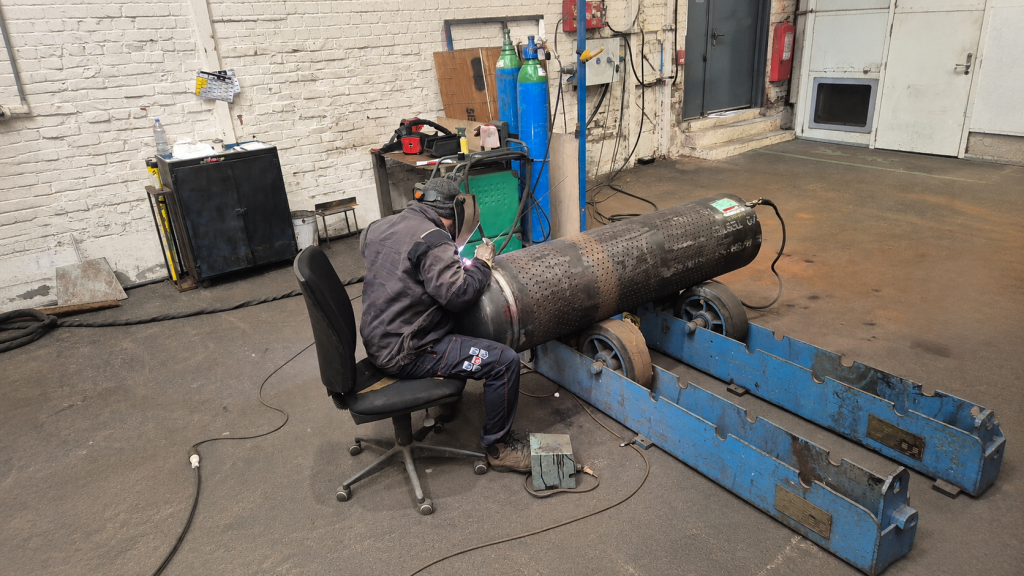
The technical design translates these decisions into detailed manufacturing specifications, incorporating on-site installation constraints from this stage onward. Manufacturing is then carried out according to these specifications, followed by installation coordinated with the on-site teams. Finally, acceptance testing verifies that the contractual performance requirements are actually met under actual operating conditions.
Continuity of information across the stages
The key advantage of this approach lies in the continuity of information. The assumptions made during the audit are directly incorporated into the study, which informs the design, guides the manufacturing process, and prepares for installation. No information is lost or reinterpreted as it passes from one service provider to another. Site teams no longer have to reconcile conflicting recommendations: they have a single point of contact responsible for the entire process.
Define, ensure, and measure acoustic performance
In an integrated approach, acoustic performance standards are contractually established as early as the design phase, rather than being verified—or disputed—at the end of construction. This early definition allows on-site teams to manage their project rather than coordinate contractors: deadlines are met, and the project is delivered without any disputes over the performance achieved.
Acceptance testing confirms, on-site and under actual conditions, that the objectives defined in advance have been met. This comprehensive process—from contractual commitment to measured verification—provides the strongest assurance for a project owner undertaking a noise reduction or regulatory compliance project.
The Groupe Boët’s Integrated Approach
The Groupe Boët manages all industrial acoustic projects, from the initial audit through to final acceptance testing, drawing on 150 years of expertise and manufacturing operations that have been relocated to France. This integrated approach covers the full range of industrial acoustic solutions: compressor silencers, blower silencers, motor silencers, acoustic enclosures, acoustic doors, acoustic grilles, and sound-absorbing panels.
The Groupe Boët’s management system is certified to ISO 9001 and ISO 19443, and its equipment complies with the EN 15085, ASME, RCC-M, CODAP, and CODETI standards. For any project involving compliance, renovation, or acoustic optimization of an industrial site, the Groupe Boët offers an initial audit to establish a single point of responsibility for the entire project. Contact us or request an acoustic study at www.groupe-boet.com.