
Summary
- Compliant, certified, qualified: three statuses not to be confused
- What a construction code concretely requires
- Industrial silencer standards: which code for which equipment?
- ISO 9001 and ISO 19443: organizational standards, not product standards
- Our method: demonstrated conformity, not merely claimed
Compliant, certified, qualified: three statuses not to be confused
Equipment is compliant with a code, a company is certified according to a standard, a welding procedure or a welder is qualified. All three are verified differently, and none replaces the other two.
Product conformity is demonstrated by a calculation note, a manufacturing file, and inspection reports. Certification results from an audit by a third-party body, which focuses on an organization or a production system. Qualification attests that a welding procedure has been tested (ISO 15614-1) and that a welder can apply it (ISO 9606-1), or that it meets the specific requirements of a code like RCC-M.
For a specifier or buyer, the consequence is direct: the mention “compliant EN…” on a brochure does not state who demonstrated conformity, nor how. The documentation does.
What a construction code concretely requires
A construction code defines the calculation method, material selection, welding, and inspections. It is on this basis that the equipment is accepted on site.
- Calculation: design pressure and temperature, allowable stresses, minimum thicknesses, corrosion allowance.
- Materials: authorized grades and acceptance certificates, often type 3.1 according to EN 10204, which link each plate to its cast.
- Welding: qualified procedures, qualified welders, and a level of requirement proportionate to the criticality of the assembly.
- Inspections: non-destructive testing (radiography, penetrant testing), hydraulic test when required, dimensional inspection.
These requirements are sequential: a deviation in a single link, a plate without a certificate, or a weld without qualification, is enough to block acceptance, even if acoustic performance is achieved.
Industrial silencer standards: which code for which equipment?
The applicable code depends on what the equipment is subjected to: pressure, nuclear environment, rolling stock, or wind action. It is derived from the equipment’s function, not its product family.
Pressure silencers: PED, CODAP, and CODETI
The diffuser stage of an atmospheric vent silencer operates under pressure. It therefore falls under the Pressure Equipment Directive (PED, 2014/68/EU), which applies above 0.5 bar maximum allowable pressure. The CLAP guidance sheet on silencer classification specifies this: only exhaust and intake silencers subjected to a back pressure less than or equal to 0.5 bar are excluded; beyond that, they are treated as pressure accessories.
To demonstrate the essential requirements of the directive, the diffuser stage is calculated, designed, manufactured, and inspected according to CODAP (Code for the Construction of Unfired Pressure Vessels). Associated piping falls under CODETI (Code for the Construction of Industrial Piping).
Installations to American standards: ASME
When the installation is designed according to American standards, the ASME family of codes applies to the equipment: the Boiler and Pressure Vessel Code for pressure parts, ASME B16.5 for flanges. The choice is not up to the supplier; it stems from the installation receiving the equipment.
Nuclear: RCC-M
The RCC-M (Rules for Design and Construction of Mechanical Components of PWR Nuclear Islands), published by AFCEN, governs the design and construction of equipment for nuclear power plants. It sets its own requirements for calculation, materials, welding, and inspection, according to the equipment’s classification level. Find our acoustic solutions for the nuclear industry.
Railway: EN 15085
EN 15085 governs the welding of railway vehicles and components, such as exhaust silencers for rolling stock. It distinguishes classes from CL1 to CL4 based on the consequences of an assembly failure: CL1 is the most demanding level.
Acoustic barriers: Eurocode
A tall acoustic barrier is exposed to wind. Its steel structure is therefore dimensioned according to the Eurocodes: EN 1991-1-4 for wind actions, Eurocode 3 (EN 1993) for structural calculation. Acoustic performance (Rw) and mechanical stability are subject to two distinct justifications.
ISO 9001 and ISO 19443: organizational standards, not product standards
ISO 9001 and ISO 19443 certify a management system. They do not demonstrate a silencer’s pressure resistance or the quality of a given weld.
ISO 9001 structures the company’s organization, from design to delivery. ISO 19443 complements it for the nuclear supply chain: it integrates specific requirements for products and services important for nuclear protection and safety (IPSN), at each link in this chain.
These certifications relate to how the company operates. The technical conformity of products and welds is demonstrated separately, equipment by equipment. During a supplier audit, both levels of evidence are therefore requested.
Our method: demonstrated conformity, not merely claimed
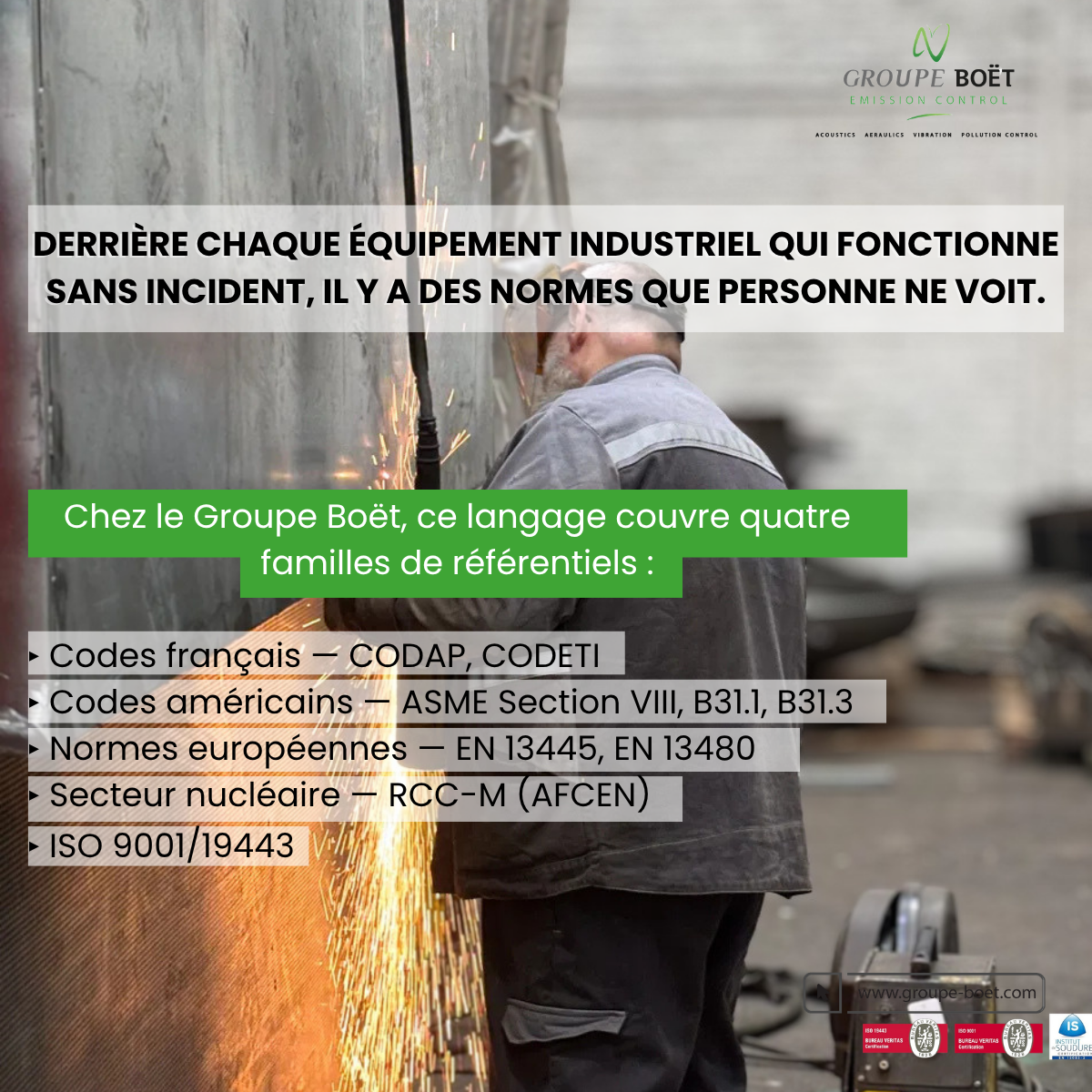
At GROUPE BOËT, each code applies to the product it concerns, and its conformity is demonstrated by three actions: a calculation according to the applicable code, welding qualified to the required level, and inspection before shipment.
Our design office and boilermaking workshop are integrated on our Tourcoing site. Welding there is qualified up to nuclear level, which allows us to apply to each piece of equipment the level of requirement its code imposes, and no more.
Our statuses are as follows:
- certified ISO 9001, ISO 19443, and EN 15085-2 at CL1 level, for the production system of our exhaust silencers;
- compliant with ASME, RCC-M, CODAP, CODETI, PED, and Eurocode, depending on the equipment concerned.
For you, the stakes are concrete: usable documentation upon site acceptance and during a supplier audit. The details of our approach are in our quality and safety policy.
Conclusion
Industrial silencer standards are read at three levels: the code demonstrates product conformity, certification governs the organization, and qualification guarantees welding. A serious supplier distinguishes these statuses and provides proof for each. GROUPE BOËT applies the relevant code to each piece of equipment and documents its conformity from calculation to final inspection.
Equipment to be manufactured according to a mandatory code? Send us your specifications.