
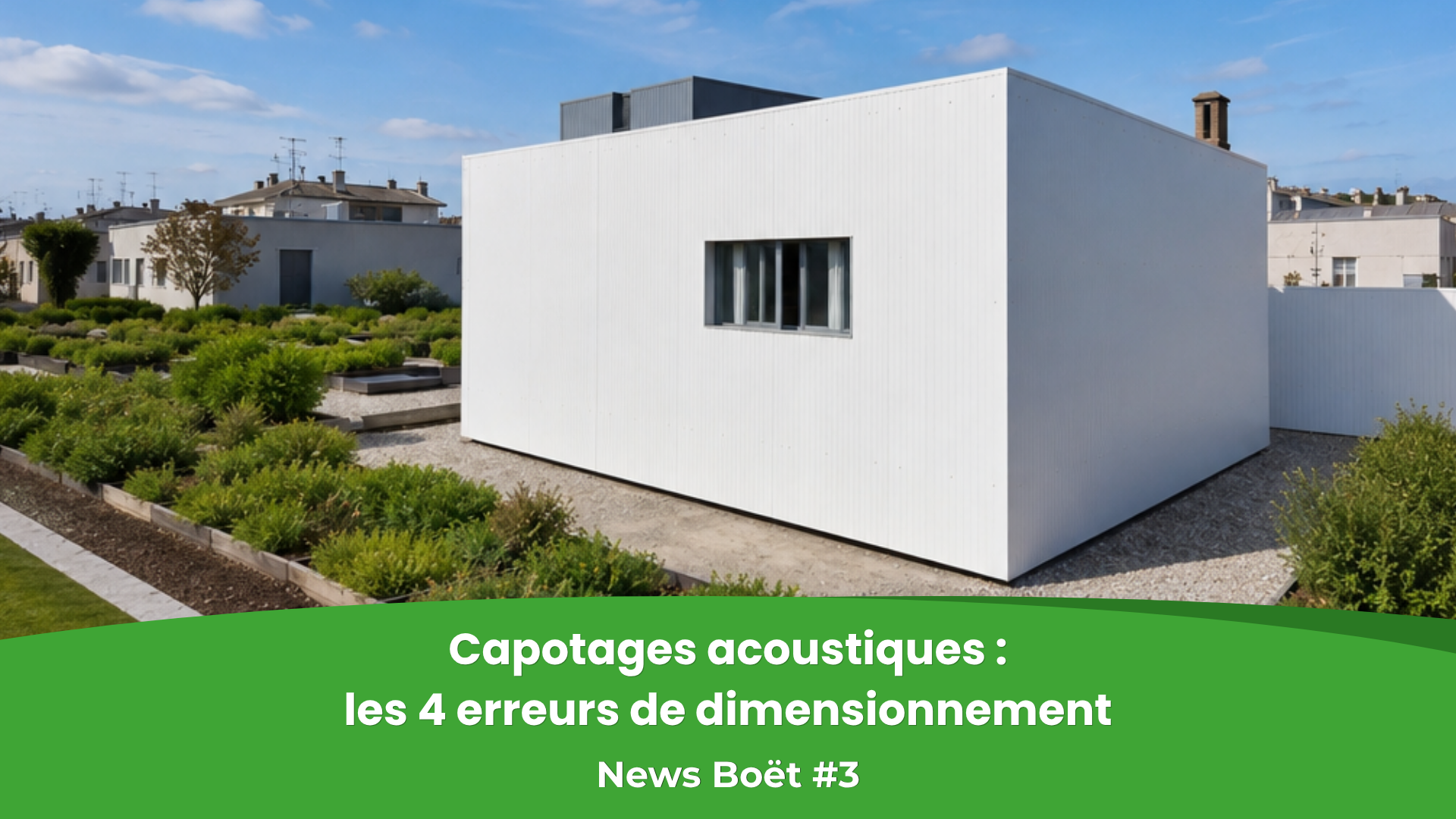
On an enclosure, decibels are rarely lost in the walls.
According to INRS, enclosures are the most common method for reducing noise radiated by a machine. It is also one of the most sensitive to details. During laboratory tests published in 2001, INRS measured the same double-walled test enclosure before and after installing a floor seal: its insertion loss increased from 19 to 45 dB(A) (Cahiers de notes documentaires n° 182, ND 2144). Same walls, same source, a 26 dB(A) difference.
An enclosure is not just a box placed around a machine. It is a shell that must simultaneously insulate, allow the machine to breathe, remain accessible, and not touch anything that vibrates. As soon as one of these functions is sized separately, it determines the overall performance.
This month, we review the sizing errors we most frequently encounter in the field, and the physical mechanism behind each.
Four errors that cost decibels
1. Ventilation: an opening sized last
An enclosed machine continues to dissipate its heat: evacuating 10 kW of losses with an air temperature rise limited to 10 °C already requires approximately 3,000 m³/h, and each air inlet or outlet is an opening in the shell. In the same tests, a single 40 × 20 cm opening reduced the insertion loss of a metal enclosure from 38 to 23 dB(A), and the loss worsened at high frequencies, which the opening allows to pass almost freely. Equipped with a silencer complemented by flexible lamellae at the inlet and outlet, the same opening brought the overall performance back to 38 dB(A), the level of the closed enclosure.
The treatment exists, but it still needs to be sized with the rest. The silencer adds a pressure drop that the fan must overcome, and the air velocity between its baffles generates its own noise. An under-ventilated enclosure causes the machine to overheat, and the temptation to operate it with open doors becomes strong: its acoustic performance disappears with them.
2. Doors and penetrations: leaks that cap performance
The insulation of an enclosure is calculated by weighting the acoustic transparency of each element by its surface area: a tiny but very transparent element can be enough to dominate the result. In theory, a gap representing 0.1% of the surface area caps the overall performance at around 30 dB, regardless of the wall quality. On another test enclosure, INRS regained an additional 6 dB(A) by treating leaks around, then under a door.
A door must therefore offer the same acoustic qualities as the fixed panels, including seals. These seals compress and are replaceable: the specification of spare parts is part of the sizing, and the labor code includes maintenance programs among the levers for reducing noise exposure (article R4434-1). The same logic applies to every cable, pipe, or shaft penetration: an acoustic sleeve provided in the specifications, not added as a corrective measure after acceptance.
3. Rigid connections: when the wall becomes the source
An enclosure treats airborne noise, not structure-borne noise. If the machine, its frame, or piping touches the enclosure, vibrations directly excite the walls, which in turn radiate like a loudspeaker diaphragm. The insulation of the panels then plays no role: the noise does not pass through the wall; it is produced by it. These vibrations concentrate on spectral lines related to the machine’s rotation, most often in low and medium frequencies, and amplify when they intersect the natural frequencies of the panels.
The solution: no rigid bridge between what vibrates and the enclosure. Machine on elastic mounts, flexible connections on pipes and ducts, enclosure isolated from the machine and its frame, damped panels if necessary. The same article of the labor code also cites the reduction of structure-borne noise, by damping or insulation, right after enclosures.
4. The spectrum: performance read as a curve, not a number
The insulation of a wall increases with its mass and with frequency, then drops around its critical frequency, which must be kept away from the machine’s emerging spectral lines. At low frequencies, efficiency also depends on the distance between the machine and the walls, which must increase as the lowest frequency to be treated decreases: an enclosure that is too tight first loses its effectiveness at low frequencies.
An enclosure specified as “25 dB(A)” without a source spectrum is therefore not properly specified. This spectrum must cover all operating regimes, as we emphasized last month: on a variable-speed machine, the spectral lines decrease with the speed, towards the area where the enclosure attenuates the least. Finally, acceptance is prepared from the specification stage: standard NF EN ISO 11546-2 frames the on-site measurement of a complete enclosure’s insertion loss for acceptance purposes, and setting this method, measurement points, and operating regimes in the specifications avoids discovering too late that what was calculated is not what is measured.
An enclosure is sized as a whole: walls, ventilation, access, penetrations, and supports, based on the machine’s actual spectrum and all its operating regimes. This is, in our opinion, the condition for the performance measured upon acceptance to match that calculated during design. – R&D Team, Groupe BOËT
QUESTION OF THE MONTH
On your enclosed installations, which of these four points has already cost you decibels upon acceptance?
The question remains open, and field feedback is invaluable. Share your experience in the comments or contact our engineering team directly. Contact Groupe BOËT.