
Introduction
This noise spike is driving new regulations at classified sites and exposes operators to noise levels that personal protective equipment cannot fully mitigate. Addressing this phenomenon requires a radically different approach from conventional ventilation or exhaust silencers: action must be taken on the mechanism generating the noise, not just on its propagation.
High-pressure discharge: a sound peak of extreme intensity
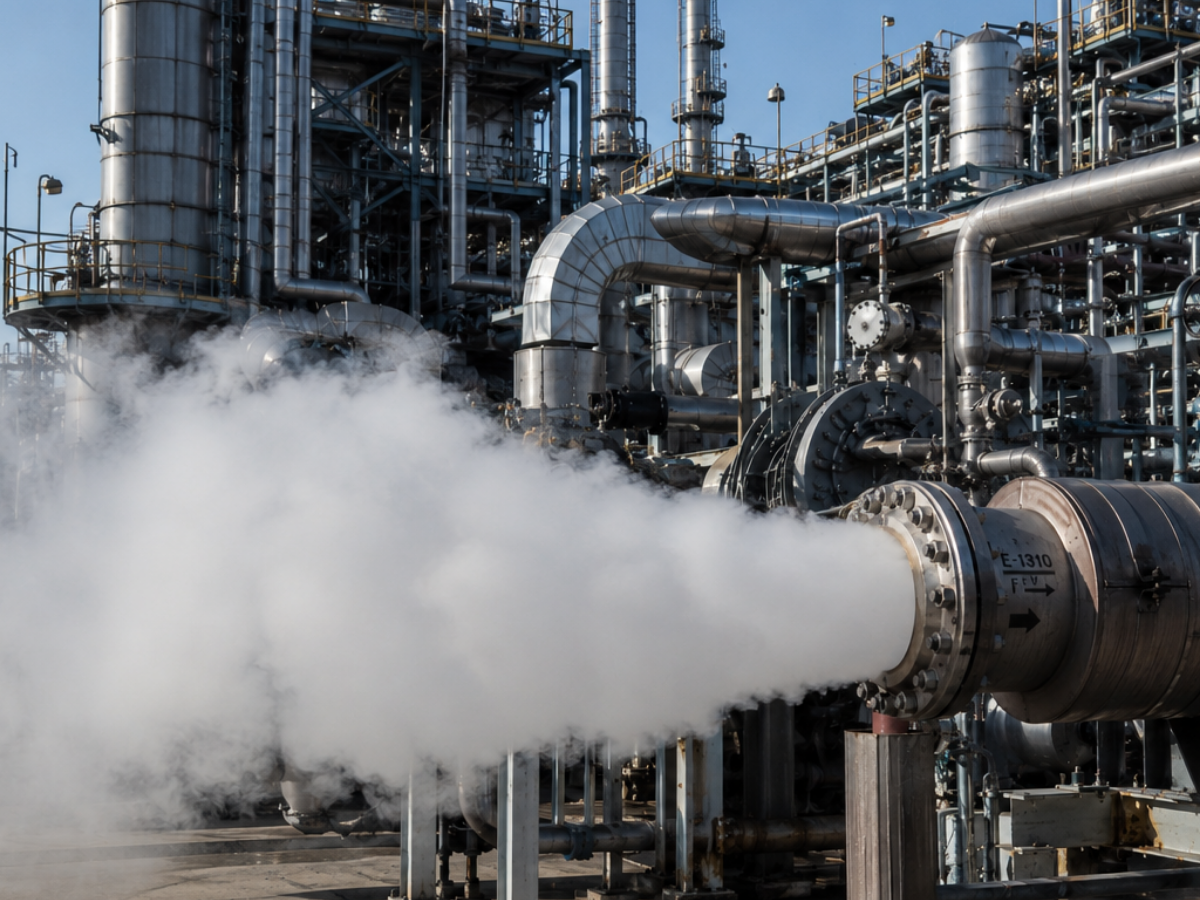
The noise produced by a steam or gas discharge into the atmosphere is a turbulent jet noise. It arises from the interaction between the rapidly expanding fluid and the surrounding air: when a high-pressure gas passes through an orifice and suddenly expands to atmospheric pressure, it generates high-speed vortex structures that produce significant acoustic radiation. The intensity of the noise produced depends directly on the jet velocity and the expansion ratio—that is, the ratio of upstream pressure to atmospheric pressure.
At a classified industrial site, a sound peak of this nature—even a brief one—contributes to the regulatory noise level measured at neighborhood monitoring points. In the workshop, it represents intense impulsive noise exposure for nearby operators. Exposure for just a few seconds to levels exceeding 140 dB(A) is sufficient to cause irreversible hearing damage, with or without personal protective equipment. Compliance with occupational exposure limits requires addressing this peak at the source.
Understanding the mechanism behind jet noise
The physics of jet noise is governed by Lighthill’s law: the radiated acoustic power varies approximately with the eighth power of the jet velocity. Reducing the ejection velocity by half reduces the acoustic power by a factor greater than 200. This principle forms the basis for the design of atmospheric vent silencers: noise reduction is achieved primarily by controlling the jet’s velocity and expansion rate, not by absorbing the sound once it is produced.
This physical understanding distinguishes the industrial atmospheric vent silencer from other noise-reduction equipment. A conventional dissipative silencer treats sound energy that has already been generated. Properly sized atmospheric vent silencers act upstream of sound generation by modifying the aerodynamic conditions of the jet itself.
The diffuser stage: acting on the noise-generating mechanism
The first stage of an atmospheric vent silencer is the diffuser. Its role is to split the gas expansion into several successive, partial expansions, rather than a single, abrupt expansion at the outlet. This division reduces the local velocity of the jet and the expansion rate at each stage, which drastically reduces the acoustic energy generated by the vortical structures.
Diffuser sizing is a custom aerodynamic calculation. The discharge flow rate, upstream pressure, nature of the fluid (saturated steam, dry gas, or wet gas), and temperature conditions determine the geometry of the orifices, the number of expansion stages, and the flow cross-sections at each level. This calculation determines the majority of the silencer’s acoustic performance: this is where the primary attenuation is achieved, up to 30 to 40 dB depending on the configuration.
DESP Compliance and Construction Codes
The diffuser is subject to the Pressure Equipment Directive (DESP), as the fluid flows through it under high pressure and temperature conditions. Its design must comply with applicable codes (CODAP and CODETI for pressure equipment in France), and its materials must be qualified for actual operating conditions. This regulatory requirement demands expertise in industrial metal fabrication—a skill few silencer manufacturers possess—combined with the acoustic expertise necessary for sizing the diffuser.
The dissipative stage: addressing residual frequencies
After the diffuser, the residual noise (primarily concentrated in the mid and high frequencies) is processed by a dissipative stage. This stage uses a filling made of sound-absorbing materials (high-density mineral wool, mineral fiber suitable for operating temperatures) to convert residual sound energy into heat through visco-thermal dissipation.
The combination of the two stages (aerodynamic diffuser and dissipative packing) makes it possible to achieve overall attenuation levels that comply with regulatory requirements for noise levels at classified sites and with occupational exposure limits. The residual noise at the silencer outlet is thus reduced to below the applicable thresholds across the entire relevant frequency spectrum.

Design and Manufacturing at the Groupe Boët
The Groupe Boët designs and manufactures atmospheric vent silencers for steam and high-pressure gases, handling everything from the aerodynamic calculation of the diffuser to in-house fabrication. This vertical integration (design office, numerical simulation, manufacturing shop) ensures consistency between the acoustic design and the mechanical performance of the equipment under actual operating conditions.
The equipment manufactured complies with the CODAP and CODETI codes for the pressurized components and with ISO 9001 and ISO 19443 certifications for the management system. Manufacturing has been relocated to France. For any venting or steam discharge project requiring an industrial acoustic study and the sizing of pressurized silencers, the Groupe Boët can be contacted at www.groupe-boet.com. See also the article on FEA and CFD numerical simulation to learn more about the aerodynamic sizing tools used in design.