
Introduction
Without treatment, venting at 75.6 bar generates a sound power level of 169 dB at the valve outlet—a level that immediately endangers on-site personnel, makes communication impossible at the site, and causes noise pollution detectable several kilometers away.
The Groupe Boët designed and manufactured a high-performance industrial silencer to address this type of application at an energy production site, while fully preserving the exhaust flow rate—a non-negotiable safety requirement.
High-Pressure Steam Venting: An Extreme Source of Noise
At an energy production facility, high-pressure steam venting occurs sporadically but is unavoidable: commissioning tests, startup purges, and overpressure situations. These events involve high mass flow rates—in this case, 313 t/h—and operating pressures reaching 75.6 bar, with direct expansion to atmospheric pressure.
In this context, noise control is critical to ensuring the safety of on-site crews, regulatory compliance with regard to nearby residents, and the ability to carry out commissioning operations without restrictions. The silencer must withstand severe thermomechanical stresses while ensuring the required noise attenuation, without restricting the exhaust flow rate, which is a safety function.
Physics of the Sound Source: Supersonic Jet and Tonal Lines
The acoustic source of a high-pressure venting event is twofold. The sudden expansion from 75.6 bar to atmospheric pressure generates a turbulent supersonic jet whose radiated acoustic power follows Lighthill’s law, being proportional to the ejection velocity raised to the 8th power. At 313 t/h, the radiated acoustic power without treatment reaches several tens of kilowatts, placing this equipment among the most challenging cases in industrial acoustics.
At the same time, shear instabilities in the jet produce low-frequency tonal noise, which is particularly difficult to address through acoustic absorption alone. This dual component—broadband and tonal—requires a two-stage noise reduction approach, combining controlled pressure expansion with viscous dissipation of residual energy.
Solution: Two-stage industrial silencer
The Groupe Boët has designed a two-stage industrial silencer, sized to simultaneously handle both the low- and high-frequency components of the source. The first stage gradually expands the steam through a series of calibrated restrictions, lowering the pressure in successive steps and eliminating the jet’s supersonic flow. It is at this first stage that the bulk ofthe noise attenuation occurs: by eliminating supersonic flow conditions, the radiated sound power is reduced by several orders of magnitude.
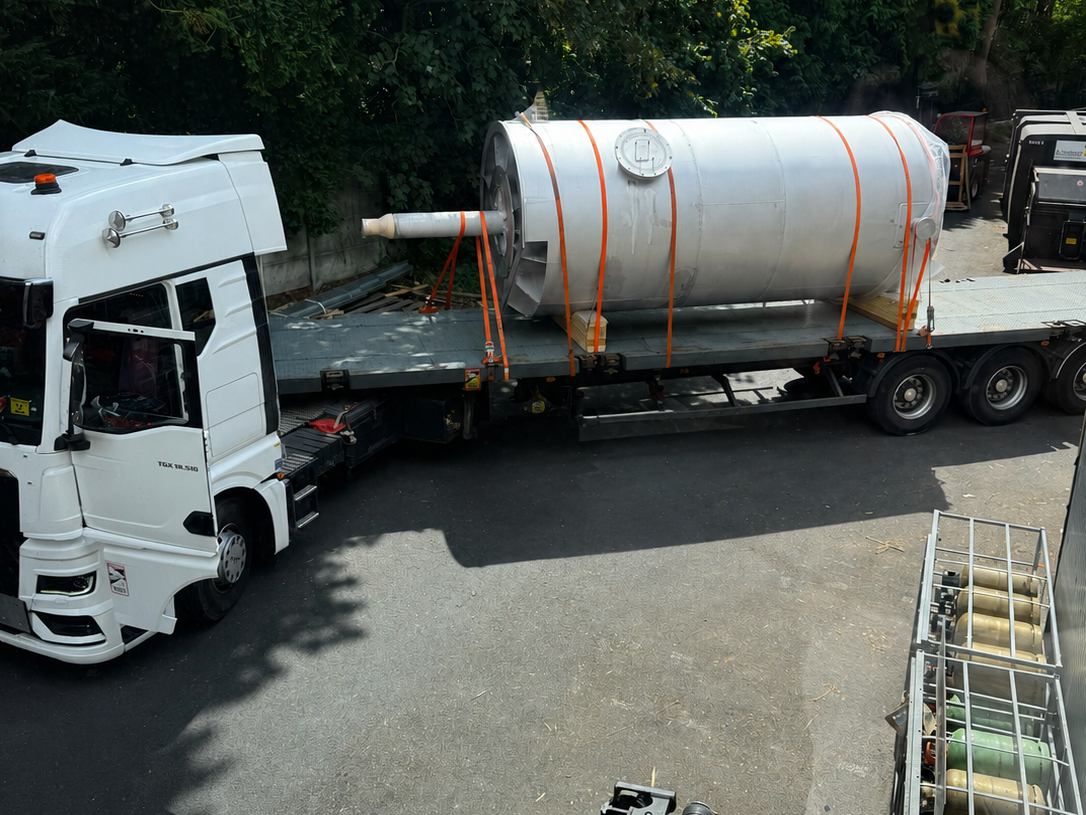
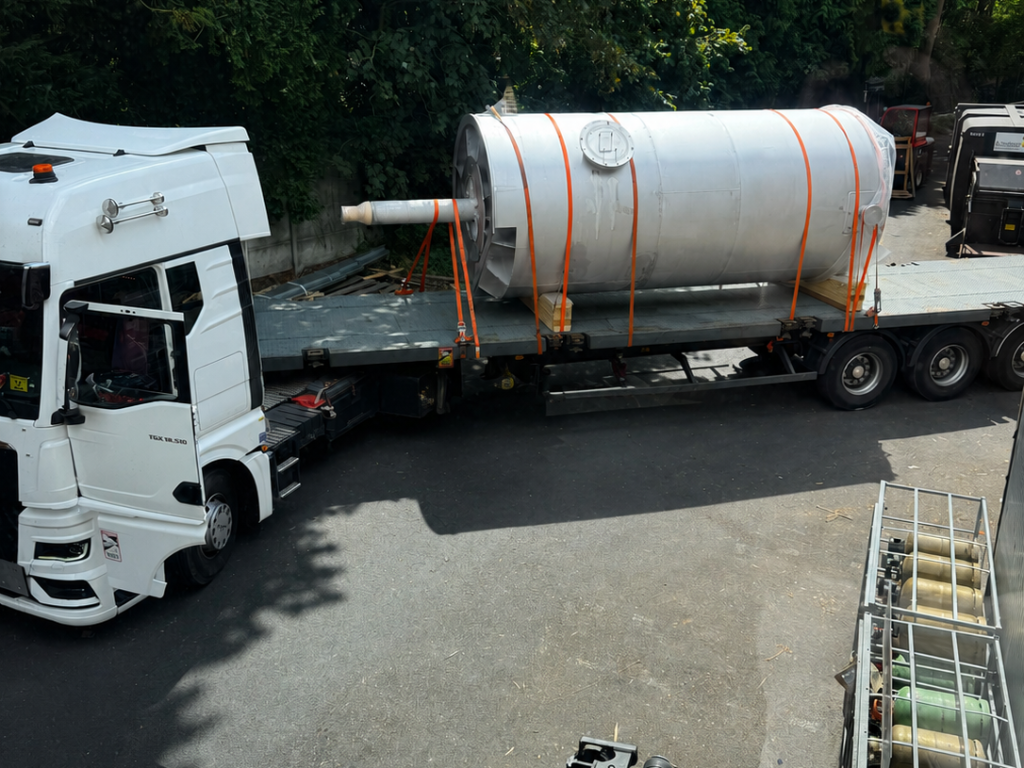
The second stage consists of a stainless steel absorber that dissipates residual acoustic energy through visco-inertial friction in fibrous packing optimized for the high-frequency range characteristic of post-expansion flow. The choice of stainless steel is dictated by the combination of residual pressure, operating temperature, and the risk of corrosion in the presence of steam. Each unit weighs five metric tons and measures 2 × 2 × 5 meters, designed to withstand severe dynamic loads in accordance with ASME and CODAP codes.
Manufacturing has been fully brought in-house by the Groupe Boët, under a management system certified to ISO 9001 and ISO 19443, in compliance with ASME, RCC-M, CODAP, and CODETI standards.

Results: 52 dB attenuation, full throughput maintained
The measured performance confirms the device’s effectiveness. The overall sound power level is reduced from 169 dB to 117 dB(A), representing an attenuation of 52 dB. The sound pressure level measured in the immediate vicinity of the installation is 109 dB(A). The exhaust flow rate of 313 t/h is fully maintained: the silencer imposes no flow restriction, fully meeting the site’s safety requirements. These results place this project among the most demanding applications handled by the Groupe Boët in the power generation sector.
High-Pressure Silencers for Power Generation Sites: Specialized Engineering
High-pressure venting applications combine extreme noise levels, severe thermomechanical stresses, and safety requirements that allow for no compromise on flow rate. The Groupe Boët manages the entire process, from acoustic modeling to certified manufacturing. For any industrial silencer project at an energy production site or high-pressure facility, contact the Groupe Boët for a technical analysis tailored to your operating conditions.