
Introduction
An industrial silencer rated at “30 dB of attenuation” may be perfectly suited for one noise source but completely inadequate for another, even if their advertised performance is identical. The reason is simple: noise is not a uniform phenomenon across all frequencies. It is distributed across a spectrum. If the equipment’s attenuation does not match the frequencies at which the source is most active, the silencer will not fulfill its purpose, regardless of the overall value listed. Choosing an acoustic silencer based on a single number means ignoring half the problem.
The Overall Decibel Level: An Inadequate Indicator
The overall attenuation of a muffler, expressed as a single number in decibels, is an average value calculated across several frequency bands. It is useful for comparing equipment in a standardized context, but it is not sufficient to guarantee compliance for an actual installation. The same silencer may provide 40 dB of attenuation at 1,000 Hz and only 8 dB at 63 Hz. If the noise source is dominated by low-frequency components—as is often the case with a compressor, a turbine, or a generator set—the 40 dB at 1,000 Hz has no effect on the actual problem.
This discrepancy between the advertised performance and the actual performance is one of the most common mistakes made when selecting noise-reduction equipment. It becomes apparent during acceptance testing, when measurements show that the residual noise level still exceeds the regulatory or contractual limit, despite the presence of a silencer that complies with its technical specifications.
Noise has a spectrum. So does its attenuation.
All industrial noise is characterized by its frequency distribution: this is its spectrum. An internal combustion engine emits dominant components at frequencies related to its rotational speed and the number of cylinders. A reciprocating compressor produces energy peaks at frequencies that are multiples of its fundamental frequency. A turbine generates broadband noise with characteristic peaks. In each case, the acoustic energy is not distributed uniformly—it is concentrated in certain frequency ranges.
Industrial silencers also have a frequency-dependent attenuation profile. Dissipative acoustic silencers with absorptive baffles are effective at mid- and high frequencies, but their attenuation drops rapidly below 250 Hz. Reactive silencers with expansion chambers offer selective attenuation focused on specific low-frequency ranges. Matching the equipment’s attenuation profile to the source spectrum is the primary condition for effective noise control.
How to Read an Octave-Band Attenuation Curve
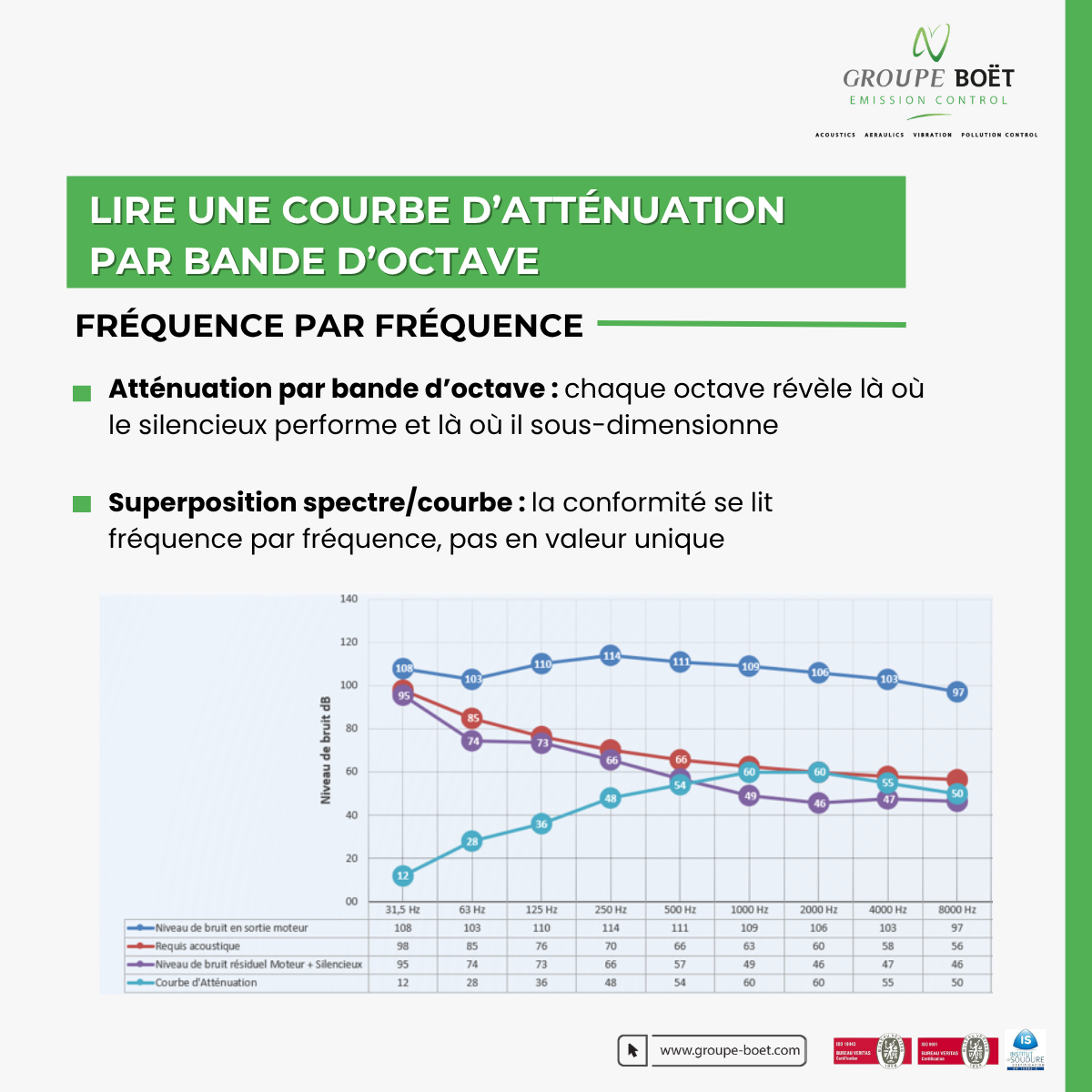
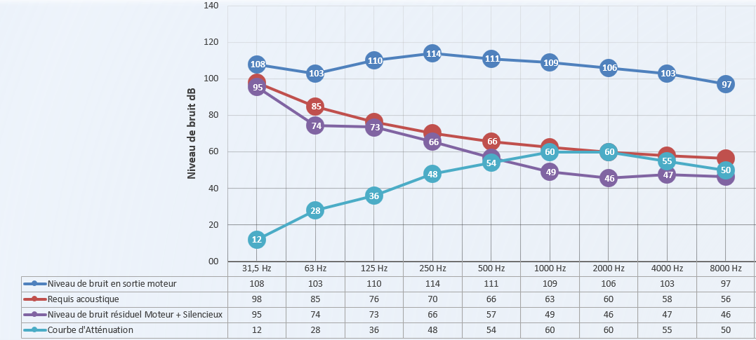
A spectral attenuation curve plots octave or third-octave bands—typically from 63 Hz to 8,000 Hz—on the horizontal axis and the attenuation in decibels for each band on the vertical axis. It allows you to immediately see at which frequencies the silencer is effective and at which it is not.
To use it correctly, plot the noise source spectrum and the regulatory or contractual limit that must not be exceeded on the same graph. The frequencies at which the source level exceeds the limit define the areas where sufficient attenuation is required. These areas guide the selection or design of the appropriate compressor silencer, motor silencer, or booster silencer.
Residual noise, the sole indicator of actual compliance
The relevant parameter is not the attenuation of the silencer considered in isolation. It is the residual noise level obtained after processing, calculated band by band by subtracting the silencer’s attenuation at the source. This residual noise, when compared band by band to the applicable limit, indicates whether the selected equipment will achieve compliance or not. It is this comprehensive spectral analysis—not a comparison of overall values—that validates or invalidates the choice of equipment.
The Spectral Sizing Method: Residual Noise by Band
Properly sizing an industrial acoustic silencer requires knowledge of the frequency response of the sound source at the silencer’s inlet. This spectrum is obtained either through on-site measurements—as part of a noise assessment of industrial sites —or from the machine manufacturer’s data, when such data is available and reliable. It is also necessary to define the target spectrum to be achieved at the output: regulatory limits, contractual requirements, or operational comfort objectives.
Subtracting the source spectrum from the target spectrum band by band yields the required attenuation profile. This profile is then compared with the attenuation curves of available equipment—whether off-the-shelf or custom-designed—to identify the appropriate solution. If no standard equipment meets the requirements across all critical bands, a custom design is necessary, with sizing guided by numerical simulation.
Sizing of Industrial Silencers at the Groupe Boët
The Groupe Boët applies this spectral sizing method to all of its industrial noise control projects. Whether the need is met by a standard silencer or requires a custom design— compressor silencers, booster silencers, motor silencers, or ventilation silencers—the starting point is always an analysis of the source spectrum and the definition of the required attenuation profile band by band.
The R&D teams use numerical simulation tools to model the spectral performance of each solution prior to manufacturing, and acceptance tests verify that residual noise remains well below the limit across the entire spectrum. The acoustic equipment manufactured by the Groupe Boët is ISO 9001 and ISO 19443 certified and complies with the EN 15085, ASME, RCC-M, CODAP, and CODETI standards.
For any requests regarding industrial acoustic studies or the design of silencers based on a measured or provided source spectrum, please contact the Groupe Boët at www.groupe-boet.com. You can also read the article on the design parameters for baffle-type silencers to learn more about dissipative attenuation mechanisms.