

Introduction
This multidisciplinary complexity lies at the heart of the work of the R&D engineer specialized in industrial acoustics. Understanding this profession means understanding how a customer requirement is transformed into a validated, documented and industrializable technical solution.
Silencer design: simultaneous technical challenges
An industrial silencer has to meet three families of requirements at the same time.
- Acoustic performance is the most visible: it defines the attenuation to be achieved over the frequency ranges concerned, as a function of the source spectrum and the target levels imposed.
- The pressure drop generated by the silencer in the fluid line must remain within the limits tolerated by the system. Equipment that is too resistive can degrade the performance of the machine it is designed to protect acoustically.
- Mechanical strength is the key to the equipment’s durability in the face of the pressures, temperatures, vibrations and corrosive agents specific to each industrial installation.
These three constraints interact.
Increasing the length of an absorber baffle improves attenuation but increases pressure drop. Reducing the cross-sectional area of the baffle reduces pressure drop, but can degrade acoustic performance at low frequencies.
The R&D engineer is the guarantor of this balance, for each project.
Its missions
The R&D Engineer’s first mission is to provide technical support during the quotation phase. When sales teams receive a complex request – a custom silencer for a nuclear application, a compressor silencer subject to high thermal constraints, a booster silencer with precise spectral requirements – the R&D engineer springs into action.
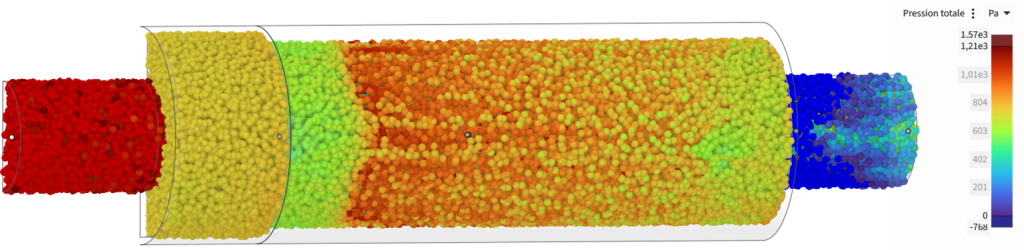
It carries out a technical feasibility analysis, evaluates the available margins and proposes a solution dimensioned using digital simulation. These tools enable us to model the acoustic and aeraulic behavior of the equipment before manufacturing, test different configurations and identify the optimum solution. The technical response provided right from the bid phase is documented and reliable, reducing the risk of revisions during the project.
This responsiveness is strategic. It enables Groupe Boët to respond to demanding technical tenders with a level of precision that distinguishes a proposal from a simple estimate.
Product development and calculation tools
Alongside pre-sales support, the R&D engineer oversees the technical development of product ranges. He/she develops new acoustic silencers, updates existing standard ranges and continuously improves the performance of Groupe Boët acoustic equipment.
A major part of this work concerns in-house calculation tools. Developing proprietary tools speeds up studies, secures results and capitalizes on feedback from the field. These tools translate analytical methods and numerical models into reproducible and auditable dimensioning processes, in compliance with applicable codes – EN 15085, ASME, RCC-M, CODAP, CODETI.
The associated technical documentation is an integral part of this work. It constitutes the company’s technical memory and facilitates the transmission of know-how between generations of engineers.
Continuous improvement as a driver of innovation
The R&D Engineer draws on feedback from delivered projects to identify areas for improvement. An acoustic non-conformity observed on site, a higher-than-expected load loss or a premature mechanical failure generate analyses that feed directly into the development of ranges and tools. This virtuous cycle between the field and the design office is one of the cornerstones of the quality of Groupe Boët solutions.
Background and skills required
The position of R&D Engineer in Industrial Acoustics requires a solid background in mechanical engineering, complemented by a mastery of numerical simulation tools. The incumbent at Groupe Boët has a degree in mechanical and production engineering, with a diploma in mechanical design from Polytech Lille in 2024. He joined the R&D team in his last year of school, under a professionalization contract, which enabled him to gain expertise in the specificities of the following fields industrial silencers before joining the company full-time.
Key skills include fluid mechanics, duct acoustics, materials resistance and simulation software. The ability to interface with sales teams, production and customers is also a determining factor: the R&D engineer must translate requirements, sometimes expressed in functional terms, into precise, verifiable technical specifications.
R&D at Groupe Boët
Groupe Boët invests in R&D as a lever for technical differentiation. Our in-house industrial acoustic studies enable us to address issues that standard solutions do not cover: high levels of attenuation, compactness constraints, corrosive or radioactive environments, compliance with international building codes.
This customized design capability is underpinned by ISO 9001 and ISO 19443 certification, continuous technical monitoring and ongoing training of our teams. It positions Groupe Boët as a technical partner capable of intervening from the earliest stages of the most complex industrial projects.
For all requests for acoustic studies, compressor silencer or engine silencer sizing, or custom acoustic equipment, Groupe Boët can be contacted via www.groupe-boet.com. Engineering profiles wishing to join an R&D team working on projects with high technical value can also apply via this channel.